How to Practice Writing
Most advice on how to practice writing starts in the wrong place. It tells you to read more, memorise grammar rules, collect vocabulary, or write a long journal entry whenever inspiration appears. Those activities can help, but they don't solve the main problem for an intermediate learner: you know more language than you can retrieve while producing a text.
The UK evidence points towards a practice problem, not merely a motivation problem. In 2026, only 28.7% of children and young people aged 8 to 18 said they enjoyed writing in their free time, and just 11.9% said they wrote something daily according to the National Literacy Trust's annual writing survey. Among teenagers aged 14 to 16, enjoyment was the lowest, although it rose from 21.4% in 2025 to 25.0% in 2026 in the same survey. Learners need more repeated production, not another pile of input.
Writing improves when you connect frequent low-stakes output, targeted correction, and gradually harder tasks. Free writing alone often plateaus because it lets you repeat familiar structures without noticing them. A useful practice system makes you produce language under a small constraint, identify the errors that keep returning, revise the text, and meet the same structures again later.
Table of Contents
- Why Intermediate Writing Stalls and What Actually Moves It
- Building Your Daily and Weekly Writing Routine
- Progressive Prompt Templates You Will Actually Use
- Feedback Loops That Actually Improve Your Writing
- Vocabulary Capture and Spaced Review That Sticks
- Tracking Progress and Setting Goals That Hold
- Breaking Through the Intermediate Plateau
Why Intermediate Writing Stalls and What Actually Moves It
At B1 or B2, you can often understand a sentence that you can't write yourself. You recognise a tense in a reading exercise, follow a complex paragraph, and understand a connector in conversation. Then a prompt asks you to explain an opinion, and you fall back on the same verbs, sentence openings, and safe vocabulary.
That gap appears because comprehension and production make different demands. Reading lets you recognise a form when somebody else has supplied it. Writing makes you retrieve the form, choose an appropriate register, build the sentence, and check whether the result means what you intended. Grammar drills may sharpen recognition, but they don't automatically train that sequence.
The UK writing data reinforces the importance of volume. In 2025, 28% of 11-year-olds in England left primary school unable to write at the expected level, while only 26.6% of UK children and young people aged 8 to 18 enjoyed writing in their free time and 10.4% wrote something daily, according to the National Literacy Trust's 2025 report. The practical lesson applies beyond school: learners need structured production, revision, and feedback rather than occasional exposure.
The three forces behind improvement
Volume gives you retrieval practice. Short texts written regularly are more useful than one ambitious essay that leaves you exhausted and then inactive for several days.
Correction shows you which errors deserve attention. If every review produces a long list of vague comments, you won't know what to practise next. Tag recurring problems by type, such as tense, agreement, word order, article, preposition, connector, or register.
Progressive difficulty stops practice becoming mechanical. Once you can handle a controlled paragraph, add a time limit, a required connector, a change of perspective, or a less familiar scenario.
Practical rule: Don't ask whether you studied today. Ask whether you produced language, corrected something specific, and used the correction again.
Free writing still has a place, particularly when you dictate past writers block with VoiceType and need to get ideas moving without stopping for every sentence. But treat the first draft as raw material. For sentence-level work, a focused guide to how to improve sentence structure can help you turn a vague sense of awkwardness into a specific revision target.
Building Your Daily and Weekly Writing Routine
A reliable routine needs a fixed trigger, a clear task, and a small version for difficult days. Treat it as a production habit, not a study habit. You aren't waiting until you feel ready. You're reserving time to make language.
Use this weekday pattern:
- Warm up for ten minutes. Retype a corrected model sentence from an earlier piece. Then transform it by changing the tense, subject, polarity, time reference, or point of view. Retyping reinforces the corrected form, while transformation makes you retrieve it rather than copy it.
- Write for twenty minutes. Use a prompt with a fixed time limit. Don't interrupt the session to search for every word. Mark gaps with a symbol, keep moving, and return to them during correction.
- Close with a quick note. Record the prompt, word count, time spent, and one recurring error. This takes little time but gives the weekly review something concrete to compare.
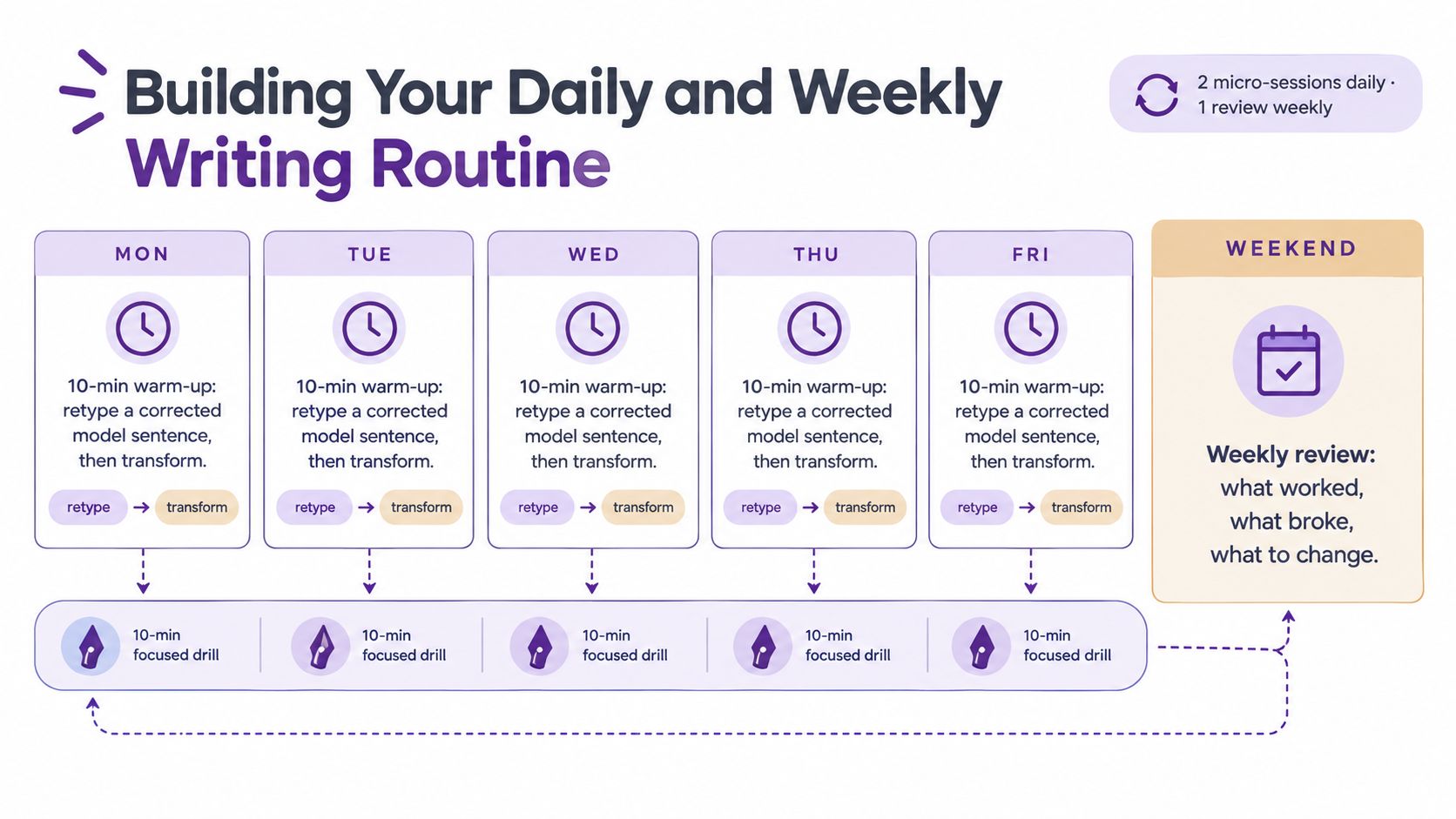
A weekly cycle gives those small sessions direction. On Saturday, write a longer 200 to 250 word text on a personal topic, such as a difficult decision, a recent journey, a workplace change, or a review of something you used. Type it or write by hand, then self-correct it using your error tags. On Sunday, spend 15 minutes comparing the week's texts, extracting recurring errors, and queuing the next prompts.
Make the routine survive bad weeks
Attach the sessions to something that already happens. Start after your first coffee, when your phone alarm rings, or at a calendar block you treat like an appointment. Use the same writing location where possible, and keep your prompt bank open before the session begins.
When energy is low, use a minimum viable version:
- Five minutes: transform one corrected sentence and write three new sentences with the same structure.
- Ten minutes: write a short response to one prompt without editing while drafting.
- Review only: correct one earlier paragraph and rewrite its weakest sentence.
The full routine can expand or contract without changing its shape. A busy day might contain one warm-up and a short prompt. A free day can add a second correction pass or a longer text. A Storyloft writing routine guide can provide another way to organise the habit, but the essential design remains the same: two small production sessions on most weekdays and one deliberate review.
If you're practising French, keep the task connected to real use with focused French writing practice, such as a message, complaint, travel request, or short opinion. Concrete situations create stronger constraints than an instruction to “write about anything”.
Progressive Prompt Templates You Will Actually Use
A prompt should make one aspect of writing unavoidable. If it only names a broad topic, you can avoid the structures you need. Build a prompt bank with the target language, grammar focus, time cap, and correction tag attached to each entry.
The examples below can work in Spanish, French, or Italian. Replace the language-specific form with the equivalent structure you're learning.
| Level | Task Type | Target Length | Grammar Focus | Success Criterion |
|---|---|---|---|---|
| 1 | Sentence transformation | 3 to 5 sentences | Tense, negation, perspective | Complete the transformations within a short timed round |
| 2 | Controlled personal paragraph | 60 to 90 words | Sequencing and past narration | Answer all three questions with connected sentences |
| 3 | Familiar opinion paragraph | 100 to 130 words | One connector and one subjunctive trigger | State a position, support it, and use the required structures |
| 4 | Comparative mini-essay | 150 to 180 words | Comparison, concession, evaluation | Weigh two options against two criteria |
| 5 | Short narrative with a twist | 200 to 250 words | Tense control, description, cohesion | Build towards a clear change or reveal |
Start with transformations
Template: Rewrite the sentence in the past, change the subject, make it negative, then express doubt.
Spanish example: Trabajo desde casa porque ahorro tiempo. Change it to describe last week, then add a doubt clause with aunque.
The success criterion isn't literary quality. It is accurate control of the target forms without translating each word from your first language.
Add controlled content
Template: Describe a recent event. What happened first? What problem appeared? What did you decide?
French example: Describe a delayed train using d'abord, ensuite, and finalement. Write a connected paragraph and underline each sequencing expression.
At Level 3, make the grammar visible in the prompt. Ask whether public transport should be free, require one contrast connector, and include a subjunctive trigger such as bien que or pour que. At Level 4, compare working from home with working in an office using convenience and collaboration as the two criteria.
Level 5 removes more support. Write a short story that begins with an ordinary decision and ends with an unexpected consequence. Keep the time cap, but postpone dictionary use until correction. Save the final version with its target structure so the same prompt can return during spaced review.
Feedback Loops That Actually Improve Your Writing
Feedback doesn't improve a text merely because somebody corrected it. Improvement happens when you understand the problem, make a decision, rewrite the sentence, and later retrieve the corrected pattern in a new context. A silent edited version is easy to admire and easy to forget.
Use three feedback sources for different jobs:
| Method | Speed | Best For | Limitations |
|---|---|---|---|
| Self-correction with error tags | Immediate | Noticing omissions, repeated grammar patterns, unclear sentences | You may miss errors you can't yet recognise |
| AI tutor prompts | Fast | Explanations, alternative phrasing, register checks, targeted examples | It can overcorrect, misunderstand intent, or give explanations you accept too quickly |
| Human tutor review | Slower | Naturalness, priorities, tone, and communicative effect | Access may be limited, and broad feedback can overwhelm you |
Begin with your own diagnosis
After writing, read the text once for meaning. Then read it again for form. Mark places where you hesitated, translated directly, repeated a word, or felt uncertain about register. Use a compact code, such as T for tense, WO for word order, P for preposition, C for connector, and R for register.
Don't correct everything at once. Choose the two or three tags that appear most often, and rewrite the affected sentences. This prevents correction from becoming a decorative exercise.
Ask AI to teach, not to polish
An AI tutor is more useful when you control the workflow. Paste the original text and ask it to identify errors without rewriting the whole piece behind your back. Request the corrected version, the reason for each change, and one new example using the same rule in the target language. Ask it to distinguish a grammatical error from a phrase that is correct but unnatural in a particular register.
Then compare its suggestions with your intention. AI feedback isn't an authority, especially when a sentence is deliberately informal or context-dependent. If the explanation doesn't make sense, test the form against a reliable grammar reference or ask a tutor.
“A correction you can't explain is not yet a correction you own.”
Finish with human judgement
Send a weekly longer text to a tutor when you can. Ask for a limited review rather than a general score: which error most affects clarity, which phrase sounds least natural, and which structure should be practised next. A human reader is particularly valuable for tone, implied meaning, and whether your text achieves its purpose.
Keep one correction log. Each row should contain the original sentence, the revised sentence, the error tag, the explanation, and a fresh example. Review the log weekly. If one tag keeps returning, turn it into the next prompt target instead of collecting another unrelated exercise.
Vocabulary Capture and Spaced Review That Sticks
Vocabulary lists fail when they separate a word from the situation that made it useful. A learner may recognise an isolated item in a flashcard and still fail to retrieve it while writing because the word has no sentence pattern, register, or topic attached.
Capture vocabulary from your own production. After each prompt, highlight unfamiliar words used in a correction, tutor suggestion, or model sentence. Select the items that you could genuinely use, not every unfamiliar expression you saw.
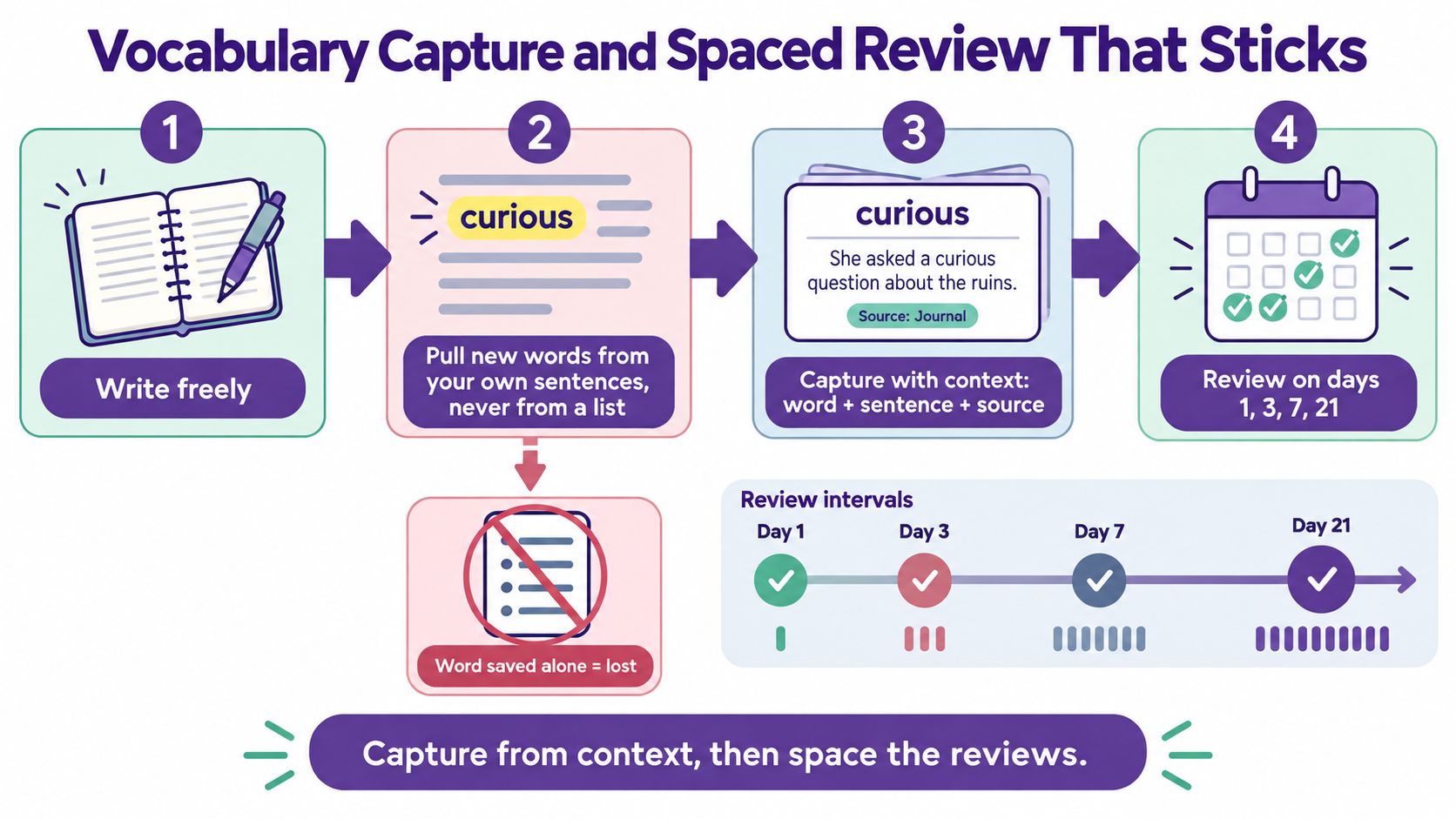
Record each item with:
- The word or phrase: Include the article, preposition, or fixed pattern where relevant.
- The original sentence: Keep the sentence from your writing or correction, not an invented definition alone.
- The source and register: Mark whether it came from a message, review, workplace text, conversation, or formal argument.
- The retrieval task: Add a question or prompt that forces you to produce it in a new sentence.
Use four review returns
Review the item after one, three, seven, and twenty-one days. On the first pass, cover the word and recognise it from the sentence. On later passes, produce a fresh sentence before looking at the answer. Each return should send the word back into writing, even if that means a two-sentence response rather than a full composition.
Alternate recognition and production. Recognition asks, “What does this mean here?” Production asks, “Can I use it accurately with a different subject, tense, or register?” The second question reveals whether the item has become available language.
A topic tag also exposes gaps. If your bank contains many travel expressions but few workplace or opinion phrases, your prompts are feeding one subject too heavily. Change the writing scenarios rather than just adding more cards. For guidance on choosing and using replacement terms, see what are alternative word suggestions.
Tools that keep vocabulary attached to the sentence can reduce the friction between writing and review. For example, LenguaZen combines AI corrections for Spanish, French, and Italian writing with a shared word bank, so a learner can save vocabulary from a sentence and revisit it in context rather than transferring items manually between separate systems. You can also adapt the same method with a notebook, spreadsheet, or any flashcard app that preserves example sentences. A practical spaced repetition schedule should serve the writing routine, not replace it.
Tracking Progress and Setting Goals That Hold
Marco's plateau became visible when he stopped measuring only how confident he felt. He had been writing 100 words three times a week, then set a target of 250 words daily. Alongside word count, he logged time spent and the number of recurring errors in each 200-word sample.
Those figures are useful because they separate output from accuracy. A larger text isn't automatically better, and a lower error count can reflect a very simple prompt. Marco needed to see all three measures together.
Build a small weekly record
A spreadsheet with four columns is enough:
| Week | Words written | Time spent | Recurring errors |
|---|---|---|---|
| Baseline | Record actual output | Record actual time | Count selected error tags |
| Current week | Compare with baseline | Note faster or slower sessions | Note repeated patterns |
| Next target | Choose one change | Keep the task realistic | Choose one correction focus |
Choose one weekly target, not five. One week might prioritise writing more quickly without stopping. The next might focus on past-tense control. Another might require stronger connectors. Keep the other measures visible, but don't try to improve every line simultaneously.
Read the numbers without fooling yourself
Marco's output rose at first, but then his word count flattened and his recurring errors remained similar. His first response was to add more writing time. That made the sessions longer without changing the problem because his prompts were still too easy and invited the same safe language.
He increased the task demand instead. He added a required contrast, changed the audience, and used a topic that needed explanation rather than description. His volume didn't need another dramatic push. His writing needed a new retrieval challenge.
Review each Friday by asking:
- Did I write at the planned frequency?
- Which error tag appeared most often?
- Did I avoid a structure because it felt difficult?
- Was the prompt too easy, too hard, or poorly defined?
- What single adjustment will make next week more useful?
The 2023 Survey of Adult Skills for England links more frequent use of writing skills at work with higher average literacy, numeracy, and adaptive problem-solving scores. It also reports that 26% of adults wrote letters, memos, or emails every day, which supports a practical approach built around regular real-world writing rather than occasional academic exercises.
Breaking Through the Intermediate Plateau
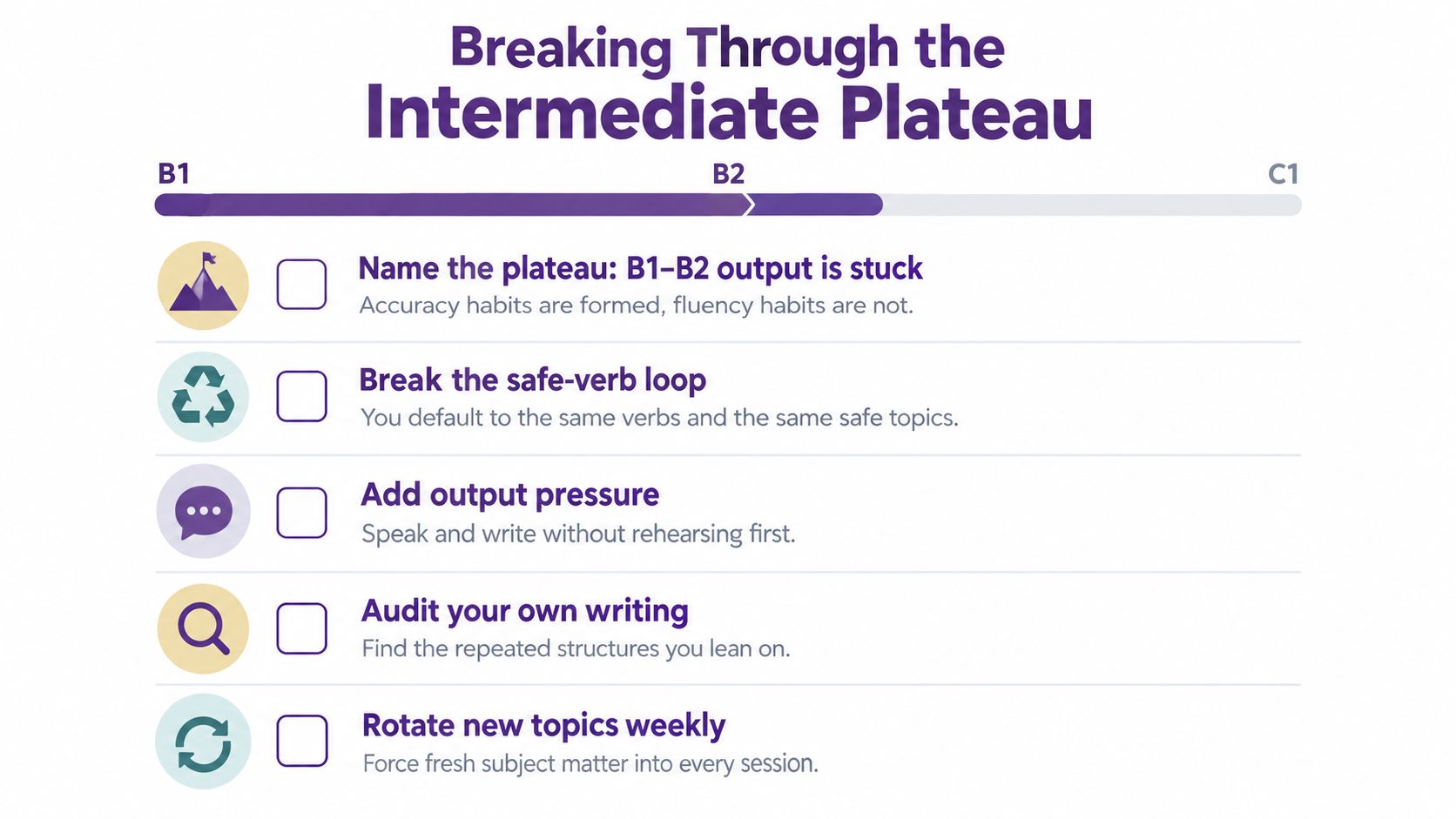
The intermediate plateau isn't mysterious. At B1 to B2, many learners have formed accuracy habits without developing equally strong fluency habits. They know which structures are difficult, so they avoid them, over-edit each sentence, and return to familiar verbs and topics.
That avoidance can look like careful writing. In reality, it often produces a narrow range of language. A learner translates word by word, replaces a precise verb with do or make, uses the same connectors, and abandons a draft as soon as a sentence becomes uncertain.
Change the shape of production
Translation drift: Stop writing from a fully formed sentence in your first language. Use an image, a short audio cue, or a sequence of three visual events. The missing source sentence forces you to construct meaning in the target language.
Subjunctive avoidance: Choose one trigger each week, such as aunque, para que, or a verb of doubt. Write several short responses where the trigger is necessary. In Spanish, you might contrast aunque es difícil with a hypothetical or uncertain situation requiring a different mood. In French or Italian, use the equivalent structure rather than memorising a disconnected rule.
Safe-verb recycling: Identify your three most frequent general-purpose verbs. Ban them from one short prompt each day, then find a more precise alternative. The restriction may initially make the text slower, but it reveals where your vocabulary is thin.
Reduce fear without removing standards
Fear of mistakes creates three unhelpful behaviours: rehearsing every sentence before writing, editing so early that ideas disappear, and choosing prompts that never require new language. The answer isn't to stop caring about accuracy. It is to separate drafting from correction.
Write the first version at speed. Mark uncertainty, but keep moving. During the second pass, correct only the selected targets. During the third pass, read for meaning and naturalness. This sequence gives fluency a protected space while preserving an exact point at which accuracy matters.
Qualifications Scotland's English writing assessment review, based on surveys of more than 1,000 learners and 400 educators, describes approaches including criterion-based frameworks, comparative judgement, authorial voice, and scenario-based assessment in its assessment review. For independent learners, that translates into a simple discipline: judge your text against explicit criteria and realistic tasks, not only against your mood or confidence.
The plateau usually breaks when you change what you demand from each session, not when you simply add more hours.
Rotate topics weekly. Write a complaint, a recommendation, a personal account, a workplace update, and a short argument. Ask an external reader or AI tutor to explain corrections rather than silently replace your sentences, then feed the recurring problem into the next prompt. A writing practice system works when every draft creates the next useful task.
LenguaZen gives intermediate Spanish, French, and Italian learners a single place to write journals, receive explanatory AI corrections, save vocabulary from their own sentences, and review it in context. If you want to replace scattered drills with a repeatable daily production and correction loop, visit LenguaZen and try the workflow with your target language.