French Speaking Practice Online for Intermediate Learners
Most advice about French speaking practice online starts with the same prescription: book more live lessons. That helps, but it misunderstands the intermediate plateau. Many learners already recognise plenty of grammar and vocabulary. Their problem is retrieving it quickly, shaping sounds accurately, and continuing when the perfect word doesn't arrive.
A weekly conversation class can feel productive while leaving the main bottleneck untouched. You speak under pressure, receive scattered corrections, then return to English-heavy work and family routines until the next session. A better system combines short daily output, shadowing, AI conversation, targeted human feedback, and review of errors in context.
French is already well established in UK language education. The British Council's language education information identifies French as the most widely taught language in the United Kingdom, while the Institut Français French courses supports more than 7,000 students each year through blended and online formats. The opportunity isn't finding one more resource. It's turning the resources you use into a repeatable speaking habit.
Table of Contents
- Rethinking the Intermediate Speaking Plateau
- Building a Daily Solo Speaking Routine
- Using AI for Judgement-Free Conversation Practice
- Structuring Live Tutor Sessions for Maximum Output
- Tracking Progress and Fixing Fossilised Errors
- Troubleshooting Common Speaking Roadblocks
Rethinking the Intermediate Speaking Plateau
More tutor hours can look like the obvious solution, yet the bigger variable is often how frequently you retrieve French aloud. One demanding conversation each week may expose a problem without giving you enough repetitions to change it. Short, regular speaking tasks create that repetition around work and family commitments.
An intermediate learner can follow a meeting, read an article, and finish a grammar exercise, then freeze at a simple follow-up question. Comprehension relies heavily on recognition. Conversation requires listening, retrieval, sentence construction, pronunciation, and social judgement at the same time. More vocabulary helps only when you can access it quickly enough to keep the exchange moving.
Adult schedules make a weekly-only plan fragile. Nottingham Trent's online French course expects 2 hours of live class plus 2–4 hours of self-study each week (course details). The Institut Français also combines self-study with live practice and role-play (course information). Both formats provide structure, but fixed sessions still need consistent work between them.
Practical rule: Reserve live sessions for feedback that benefits from a human. Use the rest of the week for brief repetitions, shadowing, AI conversations, and focused correction.
Automaticity beats another grammar list
French speaking practice online becomes more productive when each session produces spoken output. A five-minute voice note about a difficult colleague, shadowing during a commute, or an AI role-play about a delayed train can demand faster retrieval than another passive explanation of the subjunctive.
Tutors still matter. Their role shifts toward diagnosing recurring errors, correcting pronunciation, and testing whether a new structure survives real conversation. The same principle helps organisations using language school software, because scheduling, learner records, and feedback workflows can keep practice active beyond the classroom.
Grammar should answer a communication problem. Reviewing French grammar in context helps connect a rule to sentences you might say, rather than leaving it in a notebook. Aim to keep communicating with the French you currently possess, then repair the weak points that speaking reveals.
Building a Daily Solo Speaking Routine
Before speaking with a tutor or AI, become comfortable hearing your own French. Solo work removes the social penalty of hesitation and lets you repeat a sound or sentence until your mouth can produce it without conscious assembly.
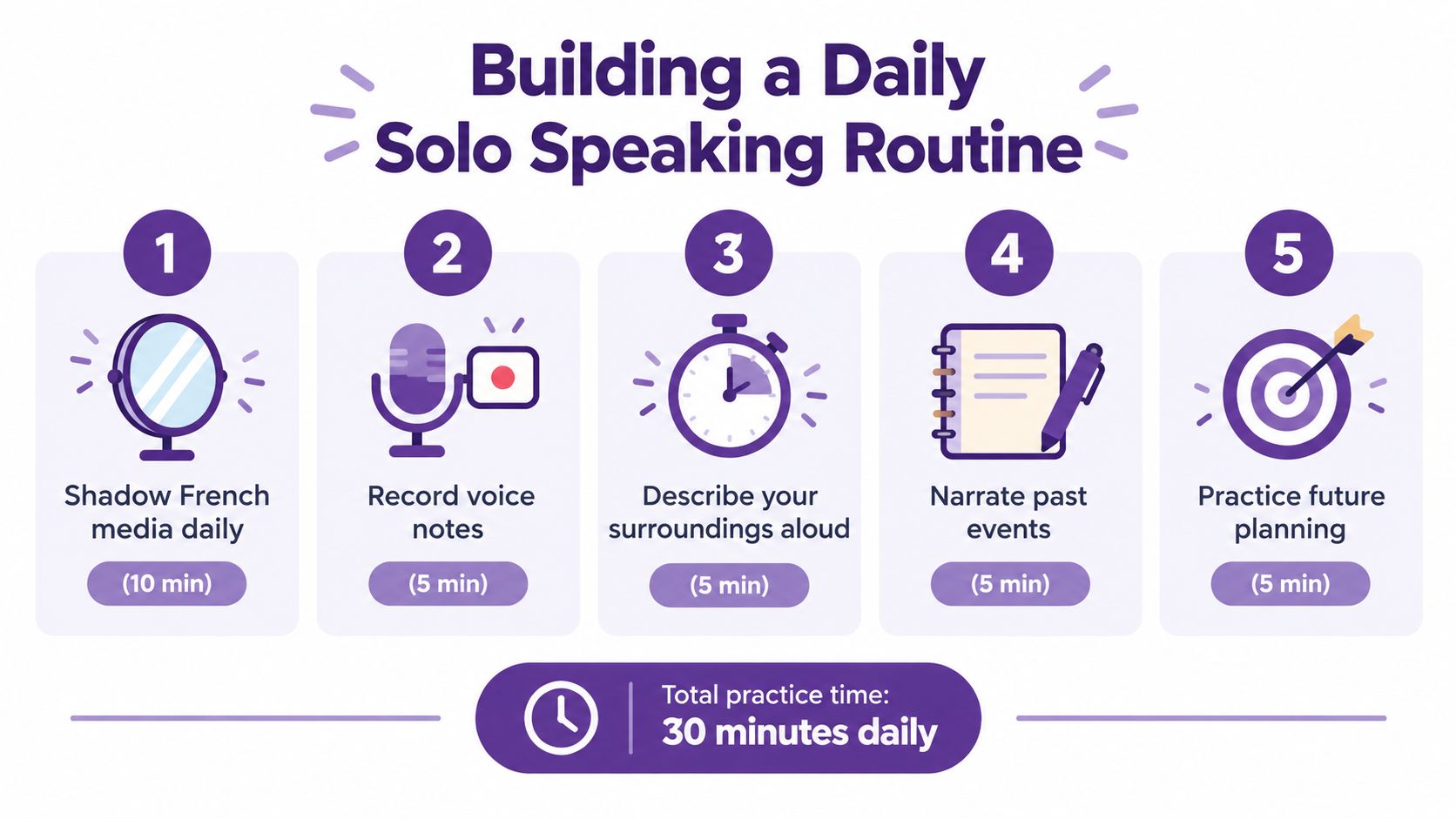
Use this routine as a flexible template. It takes roughly 30 minutes, but the exercises can be split across a morning commute, a lunch break, and an evening review.
Start with the ear, then involve the mouth
Shadow native media for 10 minutes. Choose a short French podcast, interview, or video with a transcript. Play a sentence, then repeat almost simultaneously, matching rhythm, liaison, vowel length, and intonation. Don't stop for every unfamiliar word. The first pass trains timing; a later pass can examine meaning. Synced, tappable transcripts make this easier because you can pause on a phrase without losing your place.
Record a five-minute voice note. Pick one prompt: explain a decision at work, summarise something you read, describe a disagreement, or give advice to a friend. Speak continuously. If a word is missing, describe it in French rather than switching immediately to English. Save the recording with a simple label so you can compare recurring problems later.
Describe your surroundings for five minutes. Move beyond “la table est grande”. Explain what you're doing, why the room is arranged that way, what needs fixing, and what you'll do next. This turns familiar objects into opportunities for prepositions, relative clauses, cause, contrast, and sequencing.
Narrate a past event. Tell the same story once naturally, then repeat it with attention to time markers and transitions. Useful prompts include a difficult journey, an unexpected conversation, or a project that went wrong. The point isn't literary quality. It's learning to hold a timeline in French.
Plan something future-facing. Describe tomorrow's priorities, a weekend plan, or a change you want to make at work. Add conditions and uncertainty with phrases such as si j'ai le temps, il faudrait que, and je ne suis pas certain que. Use French conversation starters when your prompts become repetitive.
Review recordings without judging your personality or accent. Listen once for flow, once for pronunciation, and once for grammatical patterns. Write down no more than a few observations, then choose one feature to improve in the next recording. A useful speaking routine creates evidence for your next action, not a new reason to feel embarrassed.
Using AI for Judgement-Free Conversation Practice
AI becomes useful when it behaves less like a translation box and more like a demanding conversation partner. A prompt such as “translate this into French” gives you a finished answer. It doesn't make you retrieve language. Voice interaction, in contrast, can force you to respond before you have time to construct a perfect sentence.
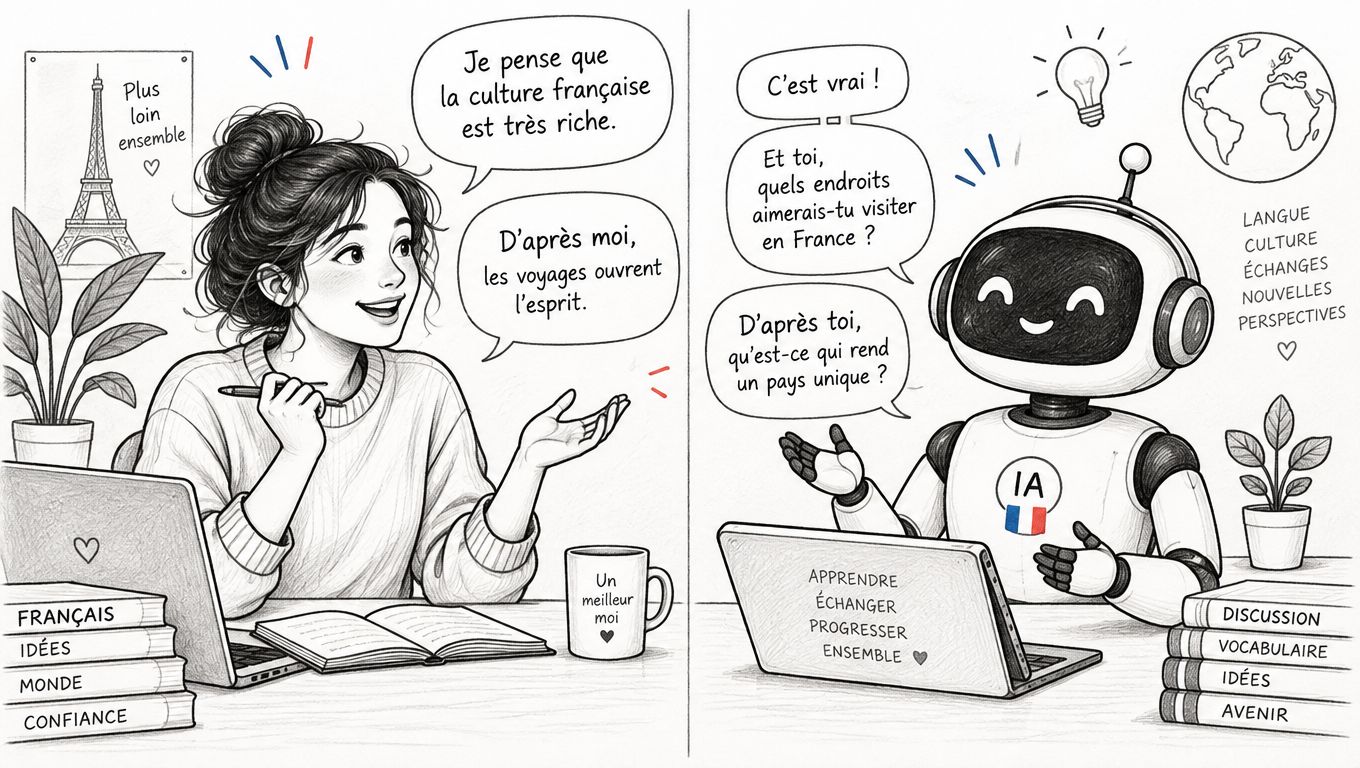
Begin each session by defining the behaviour you want. For example:
“Speak French with me at an informed conversational level. Ask one question at a time. Don't correct me while I'm speaking unless my meaning is unclear. After each answer, give me a natural reformulation, identify one important error, and ask a follow-up question that makes me use the correction.”
That instruction protects conversational flow while preserving feedback. You can then adjust the difficulty without changing the whole method.
Design scenarios that require retrieval
Good role-play doesn't let you predict every line. Give the AI a goal, a constraint, and a social relationship:
- A refund negotiation: You received the wrong item, the shop's policy is unclear, and you must remain polite but firm.
- A local issue: Discuss whether a proposed transport change would help residents. Ask the AI to disagree and request evidence.
- A work explanation: Describe a complex project to a non-specialist who interrupts whenever a concept is unclear.
- A practical failure: Report a missed connection, explain what happened, and negotiate an alternative.
- A cultural conversation: Discuss a film, meal, or news topic while the AI introduces idiomatic expressions gradually.
Ask for register control. “Correct anything that sounds translated from English” is more useful than “correct my French”. You can also request a distinction between grammatical and unnatural language, because an expression may be understandable without being the phrase a French speaker would normally choose.
If you want challenge rather than reassurance, tell the AI to use colloquial phrasing occasionally, then explain it after you respond. Voice tools are improving the ease of speaking directly to conversational systems, a development discussed in this overview of the AI-powered voice-to-text evolution. The benefit for learners is practical: you can practise turn-taking without arranging a tutor or worrying about another person's patience.
Place the video after you've tried a role-play. Watch it for ideas about interaction design, then adapt the prompts to your own needs.
Don't let AI produce a long correction report. Save only language you'll reuse. A unified word bank is particularly useful here. LenguaZen, for example, combines judgement-free AI chat with context-based vocabulary review and synced transcripts, so a learner can save an expression from a speaking exchange rather than copying isolated words into a separate list. If you're comparing ways to compare text tools, prioritise whether the workflow preserves the sentence and situation where you encountered the language.
Structuring Live Tutor Sessions for Maximum Output
A paid lesson shouldn't be an expensive version of small talk. Casual conversation has value, especially for confidence, but it often produces uneven speaking time and corrections that disappear once the call ends. A targeted session gives the tutor a clear diagnostic job.
Send a short voice transcript, an AI conversation excerpt, or a written journal before the lesson. Mark phrases where you hesitated and errors you suspect you repeat. Ask the tutor to listen for a limited group of issues, such as en and y, past-tense sequencing, vowel contrasts, or overly formal wording.
Give each part of the lesson a job
The opening should activate the relevant language, not consume the session with general updates. The tutor can then interrupt selectively, collect examples, and run a focused drill. Finish with a fresh role-play that tests whether the correction survives under pressure.
| Session Element | Passive Conversation Class | Targeted Output Session |
|---|---|---|
| Topic | Broad discussion chosen during the call | A scenario linked to a recurring weakness |
| Tutor role | Friendly participant and occasional corrector | Observer, diagnostician, and deliberate practice coach |
| Corrections | Notes may be scattered or delayed | A short ranked list with natural reformulations |
| Learner preparation | Arrive with no specific evidence | Send an audio sample or transcript beforehand |
| Final test | Conversation ends when time runs out | Repeat the task using the corrected forms |
You should still ask the tutor to let you struggle. Immediate correction after every imperfect sentence can make speech cautious and fragmented. Agree on a signal for serious misunderstandings, then reserve detailed correction for pauses or the end of a task unless the lesson is specifically about pronunciation.
Spend human time on human judgement
AI can identify patterns and generate scenarios quickly, but a skilled tutor hears social fit, pragmatic force, and the difference between technically correct French and French that suits your relationship with the listener. A tutor can also decide whether a recurring error needs explanation, imitation, contrastive drills, or just more exposure.
Use the final minutes to set one transfer task. It might be recording the same story for a different audience, using three repaired expressions in an email, or retelling the role-play without notes. The live lesson then becomes one link in a speaking loop rather than an isolated event.
Tracking Progress and Fixing Fossilised Errors
Speaking more often doesn't guarantee improvement. If you repeat the same incorrect structure without noticing it, fluency can make the error faster and harder to dislodge. Progress tracking should therefore capture what you say, not only what you understand in an exercise.
Create one review system for voice notes, AI chats, tutor corrections, journal edits, and saved listening phrases. A scattered notebook encourages random revision. A contextual bank lets you revisit the exact sentence, intention, and pronunciation problem that made the language difficult.
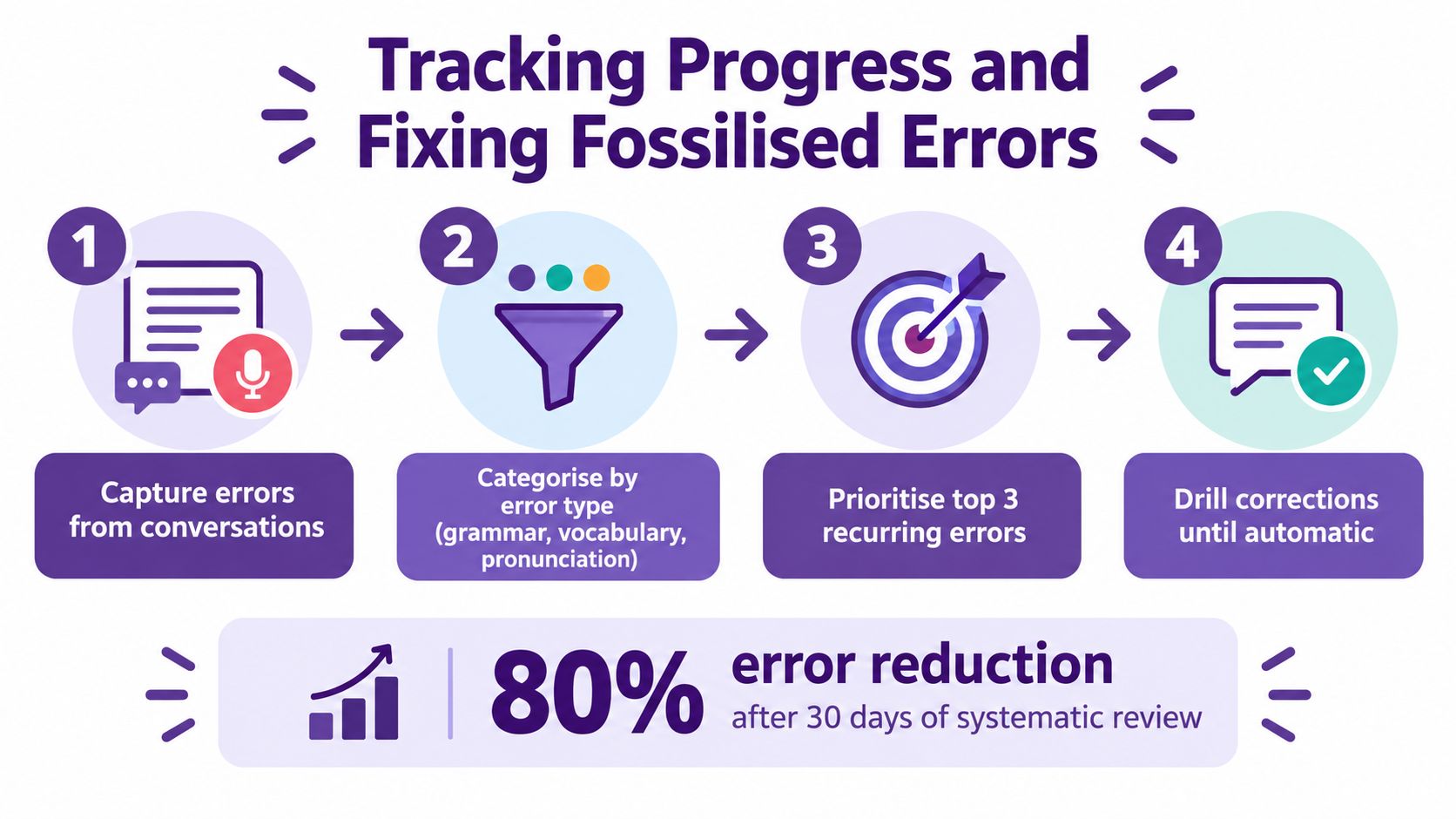
Use a small correction cycle
Capture an error immediately after a conversation. If you can't stop, record a quick note in English or French and reconstruct the sentence later. Then classify it as grammar, vocabulary, pronunciation, fluency, or register. Classification matters because each category needs a different treatment.
- Grammar errors need a corrected model plus several personal sentences.
- Vocabulary gaps need a definition, a natural collocation, and retrieval from memory.
- Pronunciation issues need a short audio model and repeated imitation.
- Fluency problems need connectors, fillers, or circumlocution practice.
- Register mistakes need contrasting versions for a colleague, friend, or service interaction.
Don't try to repair everything at once. Choose the three errors that appear most often or cause the greatest misunderstanding. A learner who repeatedly says the wrong preposition will gain more from building automatic examples around that preposition than from reviewing a broad list of unrelated rules.
Review in the sentence where you failed
Spaced repetition works better when the prompt recalls a real communicative need. Instead of a card that says “meaning of pourtant”, save the sentence you wanted to say, the corrected version, and a short cue. Later, produce the sentence aloud before revealing the answer. Then alter the subject, tense, or setting so you practise flexible retrieval rather than memorised performance.
A student progress tracker can help organise this evidence if you prefer a dedicated monitoring workflow. The tool matters less than the habit: capture, prioritise, retrieve, and test again in speech.
Review principle: An error is fixed when the corrected form appears naturally in a new situation, not when it looks familiar on a screen.
Record a fresh version of the original task after review. Compare hesitation, sentence shape, and pronunciation, but avoid treating every recording as a verdict on fluency. The purpose of measurement is to choose the next useful repetition.
Troubleshooting Common Speaking Roadblocks
A mind blank doesn't mean you know no French. It usually means the retrieval route has stalled. Keep the interaction alive with a repair phrase such as attendez, je cherche le mot, ce que je veux dire, c'est…, or c'est une sorte de…. Then describe the object, function, category, or consequence instead of translating the missing word.
Pronunciation fatigue needs a different response. Stop chasing native-speed imitation when your mouth becomes tense. Switch to slower shadowing, isolate one transition, and finish with an easy sentence you can say cleanly. Shorter practice done consistently is more useful than a heroic session that makes you avoid French the next day.
Fear of sounding foolish often grows when every utterance becomes a test. Record privately, use AI for low-stakes rehearsals, and ask tutors to correct patterns rather than interrupting every sentence. Your first objective is communication under imperfect conditions, followed by precise repair.
When work or family disrupts the planned routine, keep a minimum version ready: one minute of self-talk, one shadowed sentence, or one spoken answer to a prompt. The habit survives because the entry point remains small. Return to the fuller routine when your schedule opens, without trying to compensate for missed practice with an exhausting catch-up session.
LenguaZen brings French AI conversation, voice notes, real-world listening, contextual vocabulary saves, and tutor-style corrections into one workflow for intermediate learners. Use LenguaZen to build daily speaking repetitions around your schedule, then take the errors and questions that matter most into your live tutor sessions.