
Italian Conversation Practice That Finally Gets You Speaking
You probably know this feeling. You can follow an Italian podcast if the speaker is clear, you understand most of a menu, and you can read a short article without panicking. Then someone asks you a simple question in Italian and your mind goes blank.
That gap is where a lot of intermediate learners get stuck. Not because they need more grammar tables, but because understanding Italian and producing Italian are different skills. One is recognition. The other is fast retrieval under pressure.
I hit that plateau for years. What finally changed my speaking wasn't “more study” in the abstract. It was building a routine around short, repeatable, low-stakes output. Not impressive study sessions. Not endless note-taking. Just regular reps that trained me to answer, hesitate less, repair mistakes, and keep going.
Table of Contents
- Why Italian Conversation Feels Harder After Intermediate Level
- Building a Sustainable Weekly Routine for Speaking
- Solo and Partner Methods That Build Real Fluency
- Speaking Prompts Role Plays and Sample Dialogues to Use Today
- How to Correct Errors and Track Progress Without Losing Confidence
- Keep Speaking With Audio Video and Smart Vocabulary Review
Why Italian Conversation Feels Harder After Intermediate Level
At intermediate level, your Italian often looks better on paper than it sounds out loud. You recognise a lot. You can often tell when a sentence is right or wrong. But live conversation asks for a different chain of skills. You have to understand, choose words, build the sentence, pronounce it, and react before the moment passes.
That's why progress can feel oddly unfair. You've studied enough to notice nuance, but not enough to respond automatically.
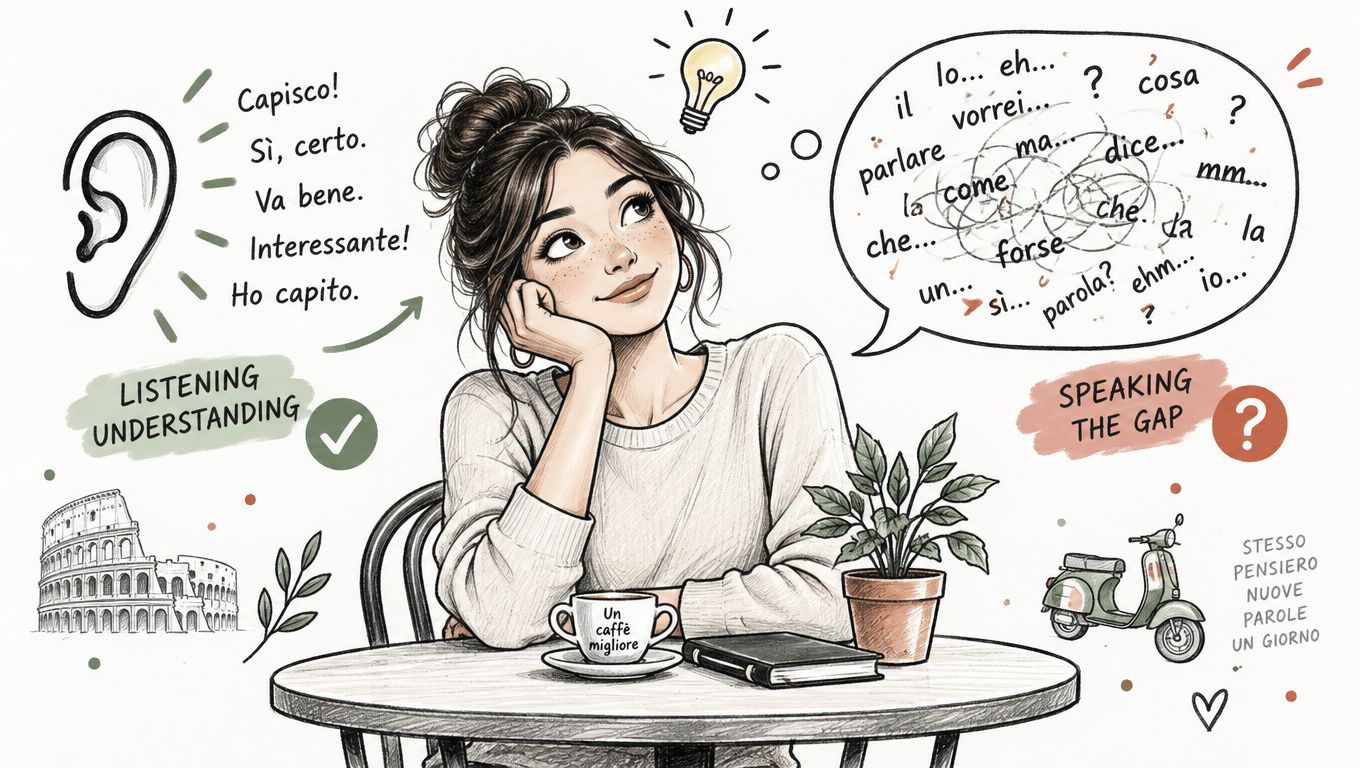
Recognition is not conversation
A lot of learners mistake recognition for readiness. You see ci penso, magari, ne ho voglia, and you understand them. Then in real speech, you don't reach for them in time. The phrase exists somewhere in your memory, but it isn't available on demand.
That's not failure. It's a training problem.
In the UK, only 2% of adults report speaking Italian well enough to hold a conversation, according to the British Council's Languages for the Future analysis. That matters because it highlights how rare actual spoken competence is compared with general interest in the language. If your speaking feels fragile, you're not dealing with a personal flaw. You're dealing with the exact bottleneck most learners never train properly.
Practical rule: If your study mainly produces recognition, don't expect it to produce fluent turn-taking.
There's a second trap here. Intermediate learners often judge themselves by lesson completion, not by minutes spent speaking without a script. Those are not the same thing. You can finish a lot of lessons and still freeze when a barista asks a follow-up question.
Why anxiety makes everything worse
Speaking trouble isn't only linguistic. It's emotional. You don't just need words. You need enough calm to use them.
That's why generic advice like “just find a tutor” often misses the point. If your real blocker is fear of sounding slow, wrong, or awkward, you need lower-pressure reps before you need harder conversations. The same principle shows up in broader communication settings too. If you want a useful perspective on how people navigate nonverbal cues in Italian meetings, it helps explain why speaking confidence isn't only about vocabulary. Timing, hesitation, facial feedback, and turn-taking all affect how safe a conversation feels.
A better target is simpler than “speak fluently”. Aim to answer faster, stay in the exchange longer, and recover when you get stuck. Fluency grows out of those smaller wins.
Building a Sustainable Weekly Routine for Speaking
Most learners don't need a heroic routine. They need one they'll repeat on tired weekdays, busy mornings, and uneven weekends.
The biggest mistake is putting all speaking practice into one long session. That creates pressure, scheduling friction, and long gaps between reps. A better routine spreads speaking across the week, with solo output on most days and one or two live conversations layered on top.
What a realistic week looks like
Use this as a template, not a rulebook.
| Day type | Main focus | What to do |
|---|---|---|
| Short weekday | Output first | Speak aloud, record, or shadow before any vocab review |
| Medium weekday | Reuse | Recycle phrases from earlier in the week into new prompts |
| Live practice day | Conversation | Do a tutor, exchange, or AI role-play session |
| Weekend | Expansion | Longer role-play, listening, and phrase harvesting |
The order matters. Start with speaking while your brain is still fresh. Leave passive review for later.
Three time-boxed versions
Some days you've got almost no time. That's fine. Keep the structure and shrink the volume.
For a 15-minute day
- Two minutes: say what you did today in simple Italian
- Five minutes: shadow a short clip and copy the rhythm
- Five minutes: answer one practical prompt, such as booking a train ticket
- Three minutes: save only the phrases you wished you'd had ready
For a 30-minute day
- Warm-up aloud: retell yesterday in the present and past
- Focused drill: one scenario, repeated three times
- Listening reuse: replay a short audio and steal two natural phrases
- Quick review: revisit saved phrases in context
If you want a cleaner review rhythm for reused phrases, a spaced repetition schedule for language learning helps stop vocabulary from turning into a pile of forgotten screenshots and notes.
For a 60-minute day
A longer session works best when it has shape:
- First block: shadowing and response drills
- Middle block: live or simulated conversation
- Final block: correction, phrase logging, and one repeat round
Don't let a long session become a reading session by accident. If the goal is speaking, your mouth should be working most of the time.
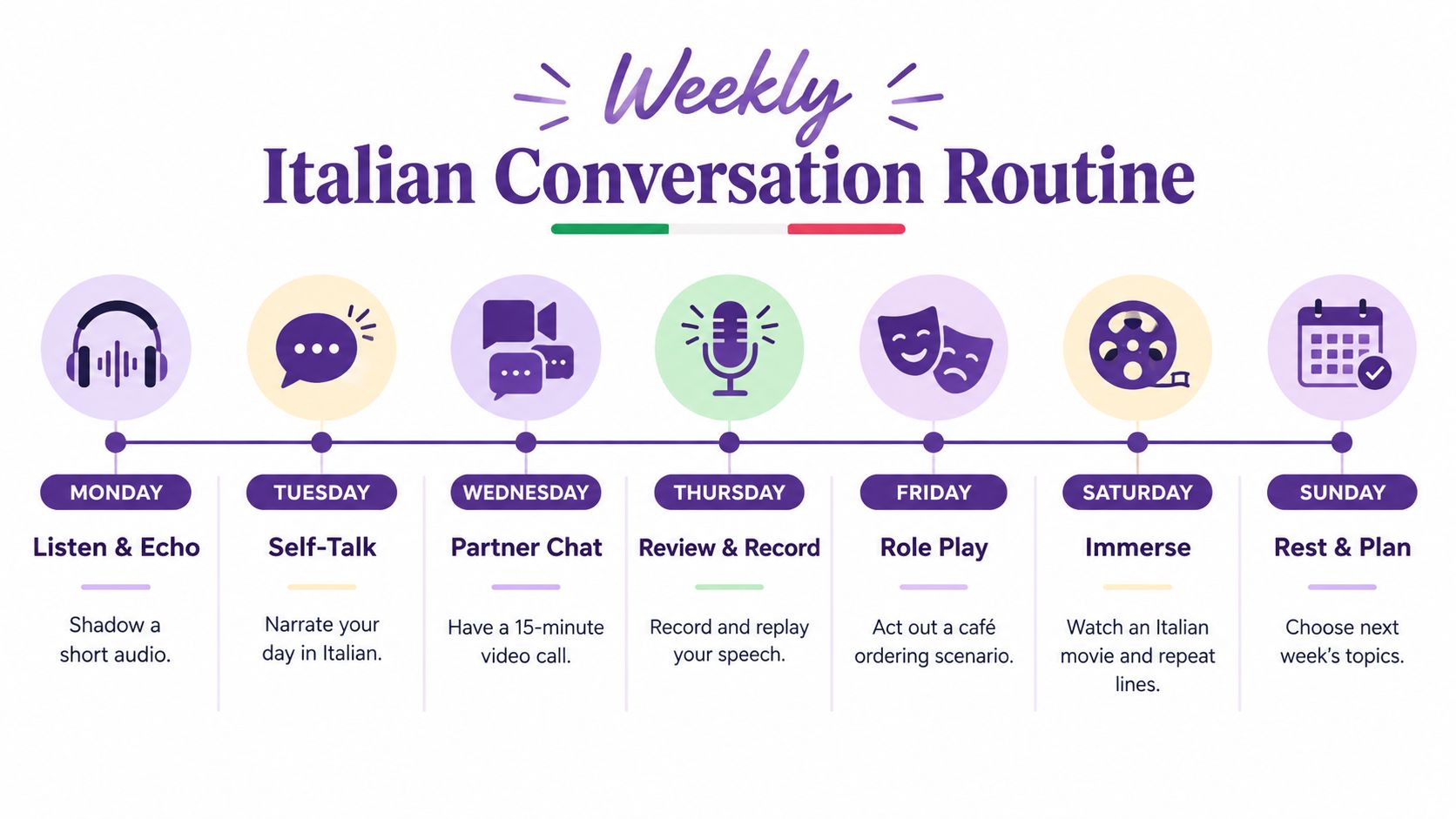
A weekly rhythm that reduces friction
Consistency gets easier when every day has a default job.
- Monday: echo and shadow
- Tuesday: self-talk while walking or cooking
- Wednesday: short partner chat
- Thursday: record and review
- Friday: role-play one everyday situation
- Saturday: longer listening plus retelling
- Sunday: light review and choose next week's topics
The best topics are boringly useful. Work updates. Travel. Ordering food. Family. Plans. Small complaints. Opinions about films or cities. Those repeat in real life, which means you get more chances to reuse the same structures until they become yours.
Solo and Partner Methods That Build Real Fluency
Solo practice and partner practice do different jobs. One builds access. The other tests it.
If you're anxious, rusty, or coming back after a break, solo work is often the fastest way back into regular output. It gives you more repetitions, less embarrassment, and space to notice patterns. Partner work matters too, but it's more effective when you're not using the whole session just trying to get your first sentence out.
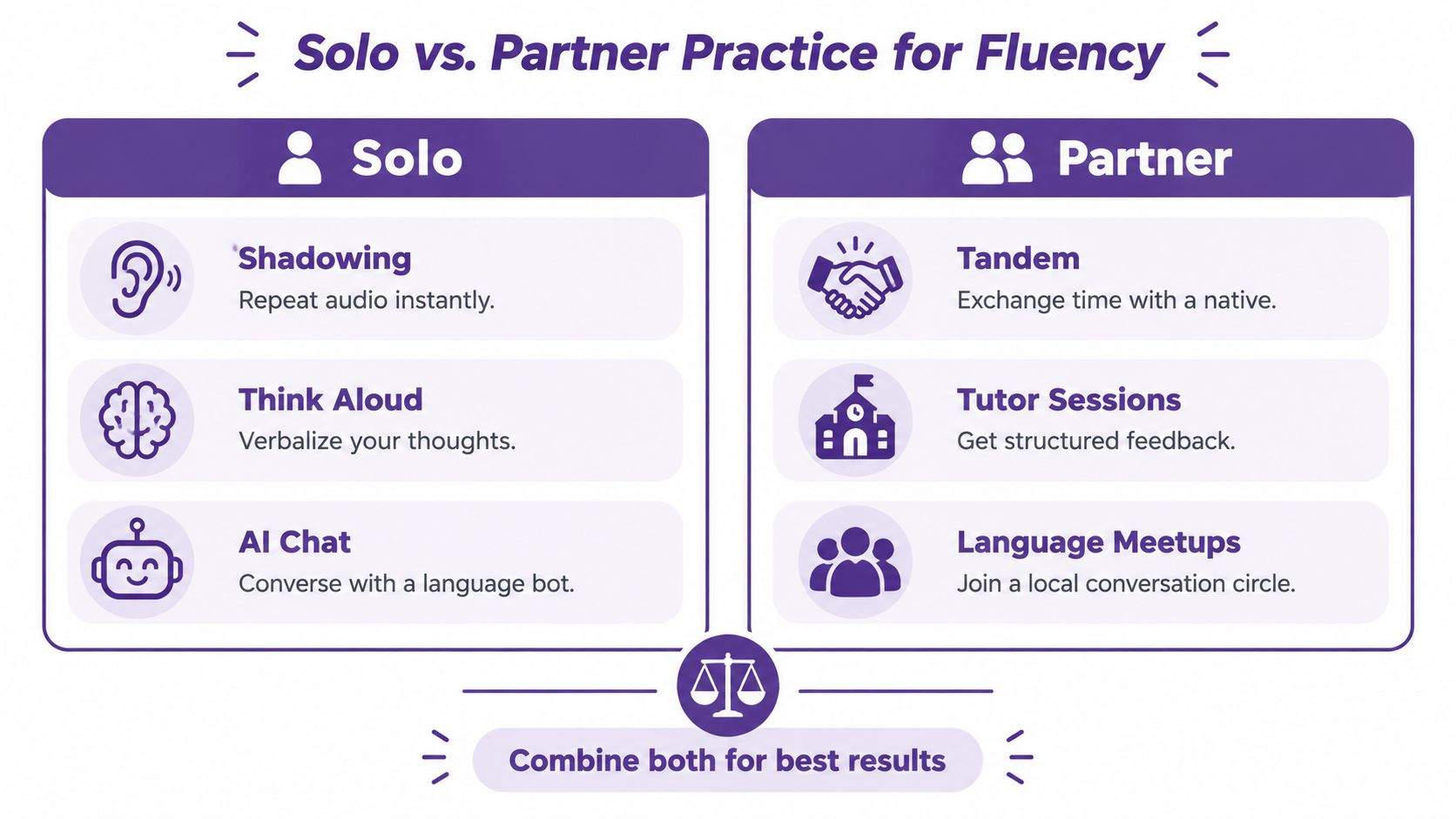
Solo methods that lower pressure
Shadowing is still one of the cleanest ways to improve flow. Pick a short clip with natural Italian, play one line, and repeat it immediately. Don't aim for perfect accent on day one. Aim to copy rhythm, linking, and sentence shape.
Think-aloud practice sounds odd until you try it properly. Describe what you're doing, what you need, what you're looking for, and what you're about to do. “Sto cercando le chiavi.” “Tra poco devo uscire.” “Non ho molta voglia di cucinare.” This forces active retrieval on familiar ground.
AI role-play can be useful when you want conversation reps without social pressure. Tools differ, but the useful ones let you repeat scenarios, ask why a phrase sounds unnatural, and stay in the same topic long enough to recycle language. LenguaZen is one option that combines AI chat, tutor-style corrections, transcripts, and saved vocabulary in one workflow, which is practical if you want speaking reps tied to later review rather than scattered across different apps.
Here's a short demo before you try your own drills:
Partner methods that create stretch
Live conversation exposes weak spots faster than solo practice. That's useful, but only if the format matches your level and confidence.
| Method | Best for | Watch out for |
|---|---|---|
| Language exchange | Casual chat and exposure | Sessions can drift into English |
| Tutor session | Structured correction | Too much correction can kill flow |
| Meetup or conversation group | Listening and spontaneity | Fast group pace can be intimidating |
A lot of intermediate learners improve faster with task-based practice than with vague free chat. Instead of “let's just talk”, use one concrete objective. Plan a weekend trip. Return a faulty item. Explain your job. Negotiate a meeting time. A task-based language teaching approach makes partner sessions much less random and gives you clearer reuse targets.
If you're nervous with native speakers, don't start with open-ended debates. Start with short, functional exchanges you can repeat.
How to combine both without burning out
A strong pattern is simple:
- Solo first: rehearse a topic, collect phrases, and do one recorded run
- Partner second: use the same topic live
- Solo after: repeat the conversation with corrections added
That loop is what turns “I've seen this phrase before” into “I can say it when needed.”
Speaking Prompts Role Plays and Sample Dialogues to Use Today
Most speaking prompts fail because they're too broad. “Talk about travel” sounds open and useful, but it often leads to pauses, vague language, and recycled beginner vocabulary. Better prompts create a scene, a goal, and one small problem.

Bar and café scenario
You're at a busy bar in Italy. You want coffee, a pastry, and clarification about what's still available.
Customer: Buongiorno, prendo un cappuccino e un cornetto, per favore.
Staff: Certo. Alla crema o alla marmellata?
Customer: Alla crema. Ah, e si può avere anche un bicchiere d'acqua?
Staff: Sì, certo. Altro?
Customer: No, basta così. Quanto viene?
Use that once as written. Then vary one detail at a time.
- Change the order: ask for takeaway
- Add a problem: they've run out of what you wanted
- Raise the difficulty: ask what they recommend and respond naturally
For solo practice, play both sides. For partner practice, ask your partner to create one complication without warning.
Train travel scenario
Travel role-plays are useful because they force questions, clarifications, and repair language.
Try this setup:
- You need the next train to Bologna.
- You're not sure which platform to use.
- Your ticket app isn't loading.
- You need to ask whether the train is delayed.
A sample exchange might sound like this:
Scusi, questo treno ferma a Bologna?
Devo cambiare a Firenze o è diretto?
Non riesco a trovare il binario sull'app.
Mi può aiutare un attimo?
The goal isn't beautiful grammar. The goal is keeping the interaction moving.
Small talk and misunderstanding repair
Intermediate learners often prepare for “important” topics and ignore the language that keeps everyday conversation alive. Small talk matters because it gives you more total speaking time.
A few prompts worth repeating:
- At work or class: comment on how busy the week has been
- With a neighbour or host: mention the weather and weekend plans
- With a friend: recommend a series, restaurant, or city
And then practise repair phrases, because real fluency includes fixing trouble without panic.
Non ho capito bene.
Puoi ripetere più lentamente?
Intendo dire che...
Come si dice...?
Aspetta, volevo dire un'altra cosa.
If you need everyday vocabulary to build these scenes out, a practical list of Italian words to know for common situations can give you enough raw material without sending you back into isolated memorisation.
How to assess these drills without killing momentum
UK evidence on school language learning highlights a general lack of confidence around speaking in class and much greater anxiety around speaking tests, as noted in the British Council's Language Trends England 2024 report. That's a useful reminder for adults too. If every prompt becomes a test, output collapses.
Use a lighter review lens:
- Did you answer quickly enough to keep the exchange alive?
- Did you recover after a mistake?
- Did you reuse any phrase from earlier this week?
That gives you accuracy work without turning every role-play into an exam.
How to Correct Errors and Track Progress Without Losing Confidence
Bad correction makes people quieter. Good correction makes them braver.
A lot of learners think they need every mistake fixed immediately. They don't. If you interrupt every sentence to patch grammar, you train caution instead of fluency. The more useful question is: which errors block communication, and which ones can wait until the end?
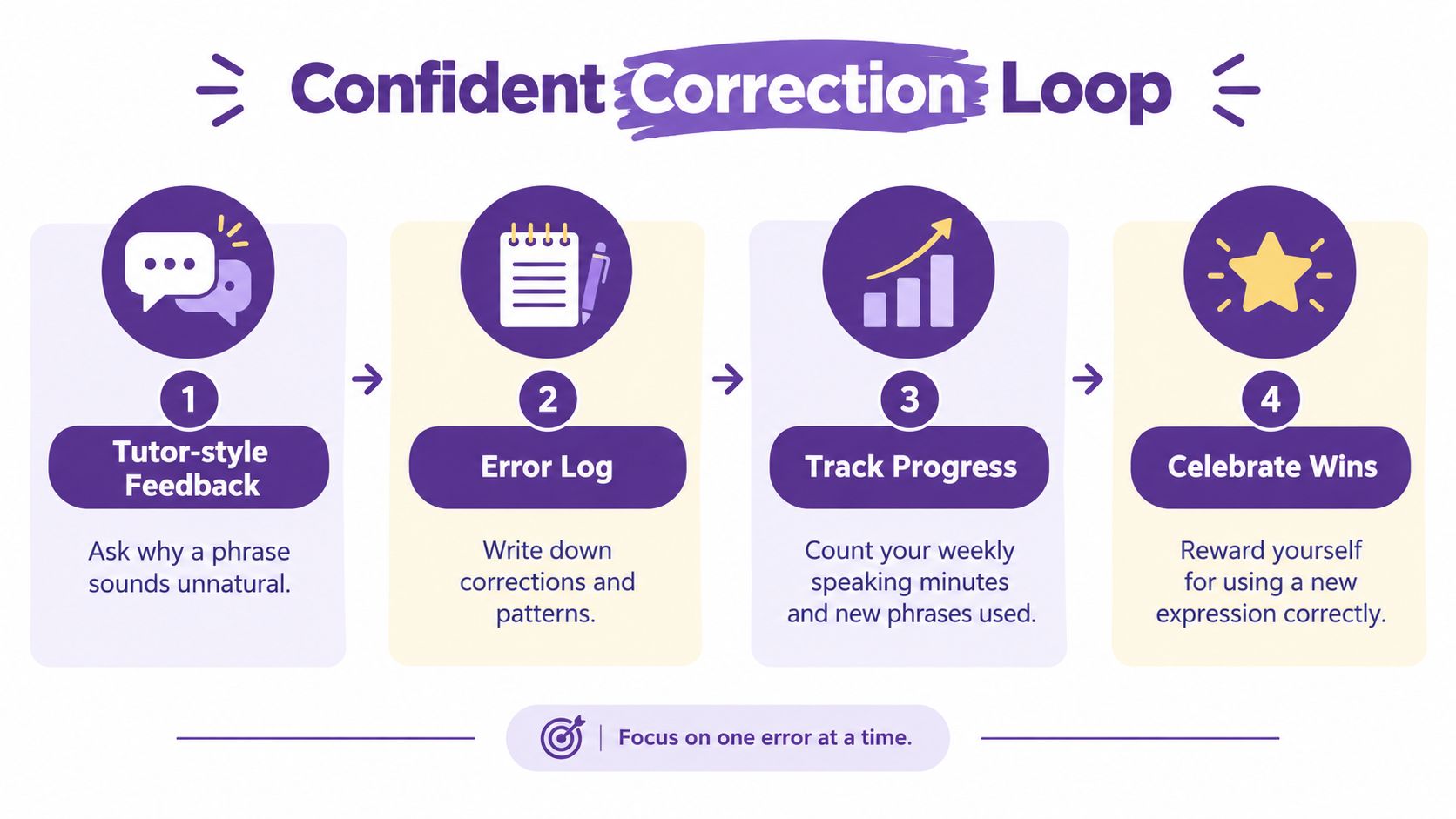
Correct for pattern, not for perfection
Good feedback explains why something sounds off. It doesn't just stamp it wrong.
Compare these two styles:
| Weak correction | Better correction |
|---|---|
| “That's wrong.” | “An Italian speaker would usually phrase that this way in this situation.” |
| “Use the right tense.” | “Your tense is understandable, but this time marker normally pulls the sentence into the past.” |
| “Say it again.” | “Keep your idea, but swap this phrase for a more natural one.” |
That style matters because it preserves the learner's intention. You're not starting from zero. You're adjusting what you wanted to say.
Ask “Why does this sound unnatural?” more often than “Is this correct?”
A self-correction loop that actually works
Recording yourself is uncomfortable at first, but it exposes habits that disappear in the moment. Don't record everything. Record one short response, then review it with one purpose.
Use this loop:
- Speak once without stopping
- Listen back and mark friction points
- Rewrite only the broken parts
- Speak again with the improved version
- Repeat one final time without looking
Notice what's missing from that list. There's no demand for a polished monologue. You're training repair, not performance.
Progress markers worth tracking
Some of the best signs of growth don't look dramatic from the outside. They feel like less strain.
Track a few things in a notebook or note app:
- Turn length: how long can you keep talking before you freeze?
- Response latency: how quickly can you answer a simple question?
- Self-repair: can you fix a mistake and continue?
- Phrase reuse: did a saved expression come out naturally later?
British Council survey evidence also shows strong motivation but weak follow-through in UK language learning attitudes. Twenty-six per cent of respondents said they regret never making the effort or finding the time to speak another language fluently, 24% said language learning is more important now than ever, and Italian was chosen by 14% as the preferred language to learn in the British Council's press summary on language learning attitudes. For practice design, the takeaway is simple. Time and confidence are the constraints, so your tracking system should reward regular speaking, not ideal study conditions.
What to log after each session
Keep the log tiny or you won't use it.
- One phrase that felt useful
- One recurring mistake
- One sentence rebuilt in a more natural way
- One moment where you handled trouble better than before
That's enough to create a review trail without turning practice into admin.
Keep Speaking With Audio Video and Smart Vocabulary Review
Speaking improves faster when listening, vocabulary, and output feed each other instead of living in separate apps and notebooks. The cleanest setup is simple. Listen to something short, steal a few phrases, say them out loud, use them in a role-play, then review them later in context.
That context piece matters. Random word lists rarely survive into conversation. Phrases attached to scenes do. If you saved ci sto pensando, remember where you met it and what problem it solved. That makes it easier to retrieve when you're speaking.
A daily loop that keeps Italian active
Try this compact workflow:
- Listen to one short clip with clear, natural speech
- Repeat two or three lines aloud
- Save only useful phrases, not every unknown word
- Use those phrases in a short spoken response
- Review them later with the original sentence attached
If you record your own responses and want cleaner transcripts for review, it helps to understand how multilingual speech-to-text explained works. Not because you need a technical hobby, but because transcript quality affects how well you can spot missing articles, tense slips, and awkward phrasing in your own speech.
A 30-day challenge that doesn't feel punishing
For the next month, keep one promise: produce Italian every day, even briefly.
Your daily minimum can be modest:
- one spoken response
- one short shadowing rep
- one phrase reused from yesterday
- one correction carried into a new sentence
The shift you're looking for is clear. You start by answering prepared prompts. Then you handle follow-up questions. Then you stay in a live exchange without mentally translating every line. That's the threshold that matters.
Italian conversation practice works when it becomes a loop, not an event. Short output. Calm correction. Reused vocabulary. More speaking tomorrow than excuses.
LenguaZen gives intermediate Italian learners one place to do that loop: AI conversation practice, tutor-style corrections, listening with synced transcripts, and vocabulary review tied to real sentences instead of isolated flashcards. If you want a lower-friction way to keep speaking every day without juggling separate tools, visit LenguaZen.