10 Language Learning Techniques for Intermediate Learners
More beginner drills rarely solve the intermediate plateau. Once you can follow familiar topics, recognise common grammar and make yourself understood, the problem is usually integration, not a shortage of isolated vocabulary. You need to connect what you understand with what you can produce, notice how real speakers phrase ideas, receive useful correction and meet the same language again in new contexts.
That matters in the UK, where language pathways are uneven. The British Council's Language Trends 2025 survey covered more than 1,000 schools and found that modern foreign language GCSE uptake is more than 20 percentage points higher in the most affluent state schools than in the least affluent ones. It also found that 68% of the least affluent schools reported difficulties recruiting language teachers. Progress depends partly on whether learners can keep practising when formal support becomes inconsistent.
The ten language learning techniques below form one workflow: understand authentic language, capture useful context, produce it, correct it and recycle it through realistic tasks. Each technique includes practical steps, trade-offs, Spanish, French and Italian examples, adaptations for busy schedules and measurable signals that show progress without promising instant fluency. LenguaZen is one example of a unified environment that brings input, contextual vocabulary, output, corrections and review into the same workflow.
Table of Contents
- 1. Comprehensible Input
- 2. Spaced Repetition Systems
- 3. Free Speaking and Output Production
- 4. Immersive Media Consumption with Active Vocabulary Extraction
- 5. Structured Dialogue and Role-Play Scenarios
- 6. Journaling and Written Output with Corrective Feedback
- 7. Contextual Vocabulary Building
- 8. Listening Comprehension with Transcripts and Variable Playback Speed
- 9. Spaced Reading with Repeated Encounter and Active Annotation
- 10. Focused Grammar Study with Contextual Application
- Comparison of 10 Language Learning Techniques
- Build a Routine That Survives Busy Weeks
1. Comprehensible Input
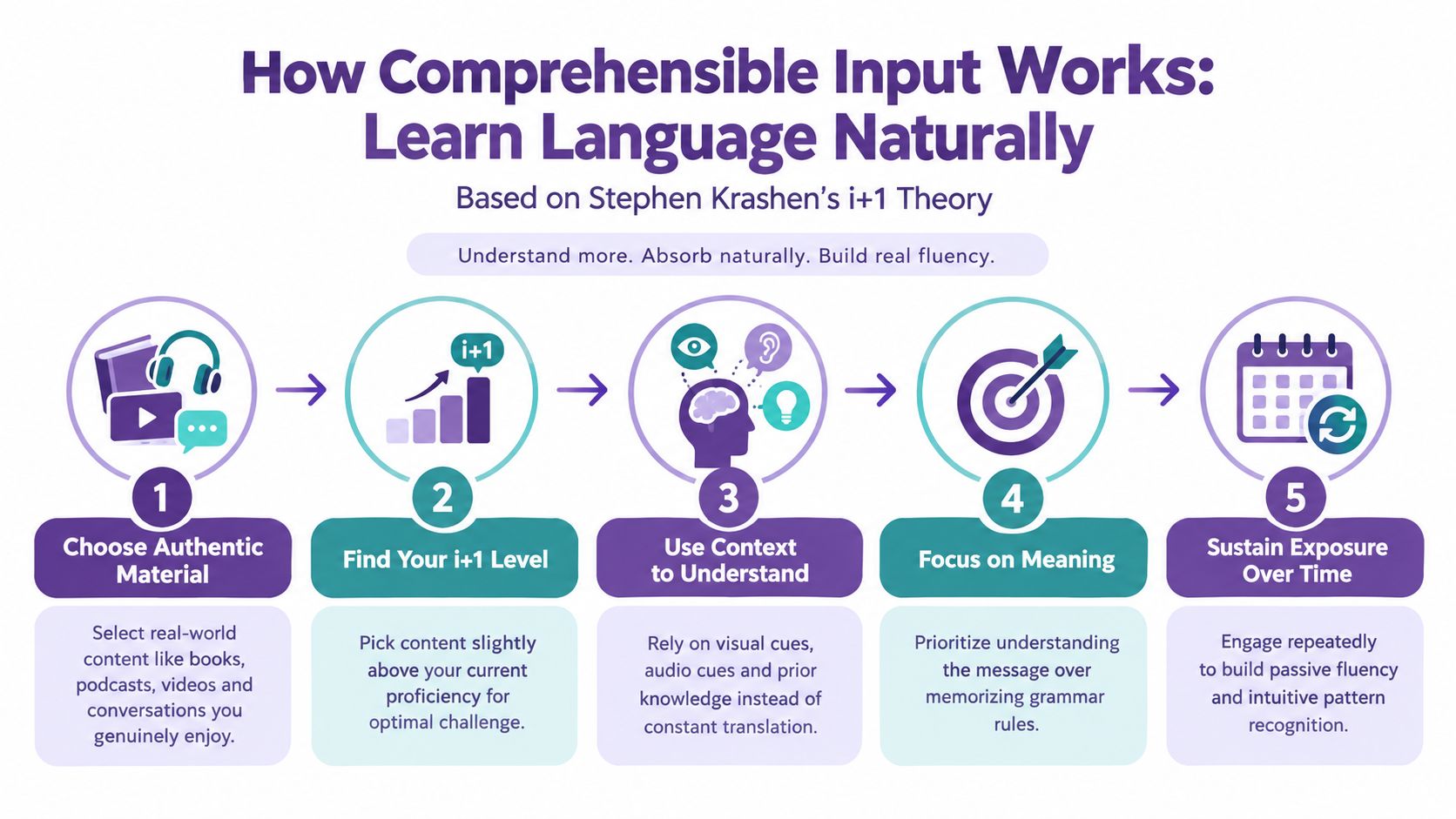
Intermediate learners need material they can mostly follow while still encountering useful stretches of unfamiliar language. This is the practical meaning of comprehensible input. Context, topic knowledge, visuals and repeated exposure help you understand meaning without translating every sentence.
The trade-off is difficulty. Content that's too easy reinforces what you already know but creates little pressure to notice new patterns. Content that's too difficult turns every minute into dictionary work. Choose material that challenges your attention while allowing you to follow the overall message.
Make understanding the main task
Start with subjects you already care about. A Spanish learner who follows football might watch match analysis in Spanish, while a French learner interested in food could use recipe videos or interviews with chefs. An Italian learner who enjoys design might read articles about architecture rather than forcing themselves through a generic textbook.
Use target-language subtitles or transcripts when they clarify the audio. Tap or note an unfamiliar phrase, then return to the content instead of pausing every few seconds. Flow matters because you're learning how words function inside an unfolding message, not just collecting translations.
Practical rule: Save language that helps you understand the content or express something you genuinely want to say. Ignore the rest on the first pass.
A repeatable routine
- Choose one short source: Use a video, podcast, story or article connected to a real interest.
- Follow the main meaning: Accept partial understanding and avoid translating line by line.
- Revisit the same material: A second exposure often reveals phrases you missed initially.
- Capture selectively: Save recurring or personally useful expressions for later review.
- Produce a response: Summarise the content aloud or write a brief reaction.
A Spanish learner might watch the same interview first with Spanish subtitles and later without them. In French, you could listen to a news discussion and write down the speaker's main argument. In Italian, retelling a travel video forces passive understanding into active use. LenguaZen can support this sequence through imported video, transcripts and contextual saving, while its practice feedback process offers a useful model for connecting exposure with correction.
Measure progress by recording how much of a familiar clip you can explain without translating, not by counting every word you recognise. If your summary becomes more detailed and requires fewer pauses, your comprehension is becoming more usable.
2. Spaced Repetition Systems
Spaced repetition works best as a recycling mechanism, not as your entire language course. You review an item shortly before you're likely to forget it, then encounter it again after longer intervals as recall strengthens. That makes it useful for vocabulary and phrases that authentic exposure alone hasn't yet made reliable.
The common failure is adding too many cards. A large queue can turn language learning into administration, and isolated cards often produce recognition without flexible use. A card for prendre or andare is weaker than a sentence showing how the verb behaves in context.
Build cards from real encounters
Save the complete sentence where you found the item. Include enough surrounding information to show meaning, register and grammar. For example:
- Spanish: Me di cuenta de que había dejado las llaves en casa.
- French: Je me suis rendu compte que j'avais oublié mon portefeuille.
- Italian: Mi sono accorto che avevo lasciato il telefono sul tavolo.
These examples do more than teach a translation. They show a useful expression, a tense relationship and a realistic phrase pattern.
Keep review sessions short enough to repeat consistently. If you're using Anki, Memrise or a word-bank system such as LenguaZen's SuperMemory, rate difficulty. Marking every card as easy may make the session feel smoother, but it gives the system poor information and weakens future scheduling.
Connect review to production
After reviewing a phrase, create a new sentence about your own life. A French learner might write Je me suis rendu compte que j'avais oublié de répondre à un message. A Spanish learner could adapt the structure to a work situation, while an Italian learner might use it in a short spoken account of their morning.
Use sentence-based spaced repetition vocabulary practice to keep review tied to meaning rather than a bare English equivalent. Your progress signals should include whether you can recognise the phrase, recall it from a prompt and use it in a new sentence. Those are separate abilities, so don't treat a correct flashcard answer as proof that the expression is ready for conversation.
3. Free Speaking and Output Production
You can understand a great deal and still freeze when somebody asks an unexpected question. Intermediate learners often need more opportunities to assemble language under pressure, with enough support to keep speaking but not so much that every response becomes scripted.
Free output includes speaking, writing, voice notes and real conversations. The aim isn't flawless performance. It's learning which words you can retrieve, where you hesitate and which grammatical choices collapse when you have to communicate quickly.
Lower the social cost
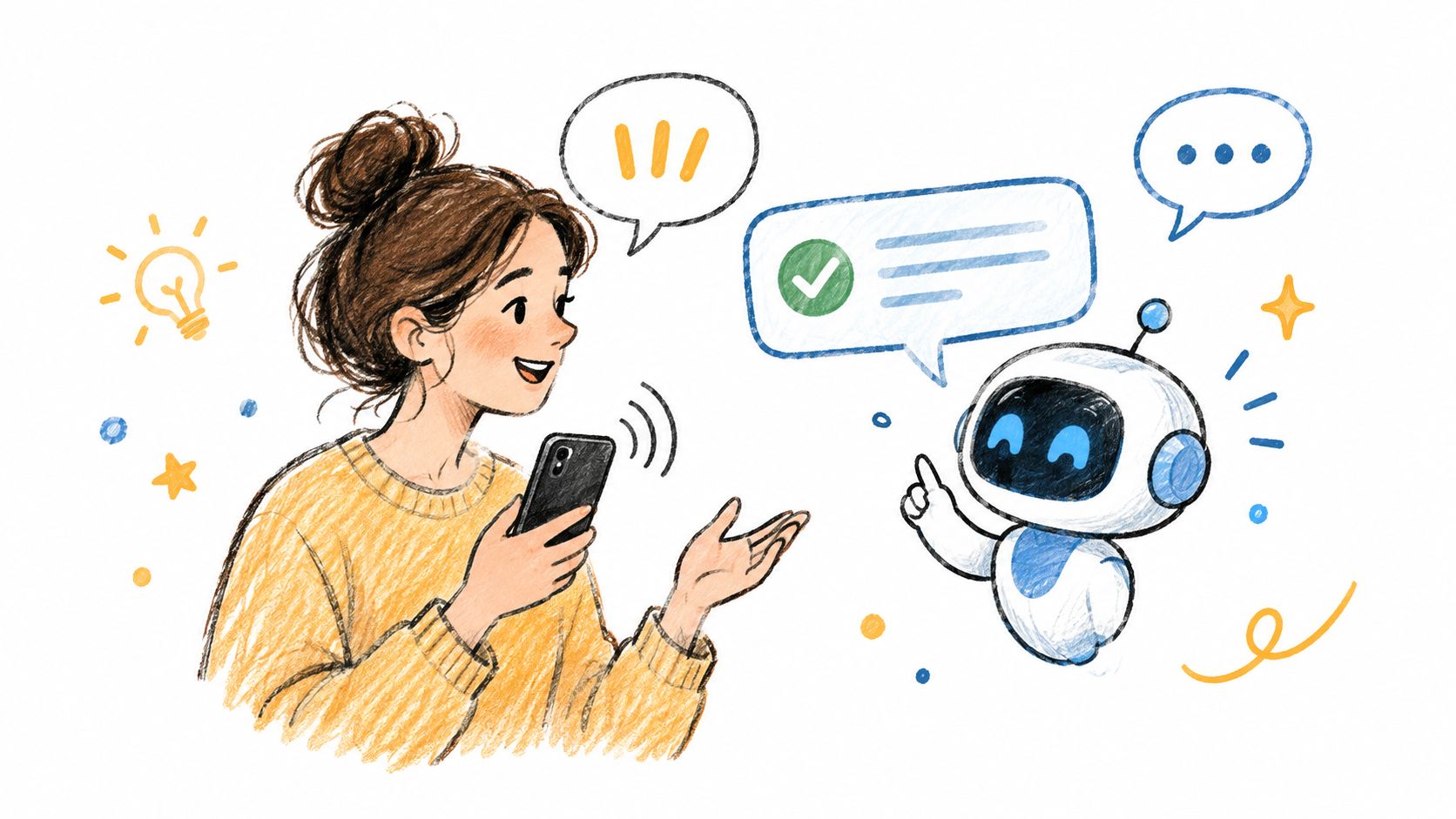
A judgment-free AI chat can provide useful repetition when a tutor or partner isn't available. LenguaZen's AI chat is designed for speaking practice, while platforms such as italki connect learners with conversation partners and Speaky supports peer exchanges. Each option has a different trade-off. Human conversations bring unpredictability and genuine interaction, while AI practice offers privacy and repeatability. Neither replaces the other completely.
Set a narrow communicative target. “Speak better” is too vague, but explaining your weekend, comparing two restaurants or describing a workplace problem gives you something observable to practise. Prepare ideas, not a memorised script.
Turn mistakes into training data
Record yourself answering the same prompt at intervals. Listen for pauses, repeated English fillers and words you avoided. Then ask for specific feedback, such as whether your Spanish subjunctive sounds appropriate, whether a French phrase feels formal or whether an Italian sentence sounds natural.
Useful output can be brief:
- Spanish: Explain why you changed a plan, using porque, aunque or sin embargo.
- French: Describe a disagreement and say what you would do differently.
- Italian: Give directions to a place you know, then answer an imagined follow-up question.
Track speaking duration, completed ideas and the number of times you recover after getting stuck. A longer recording isn't automatically better, but the ability to continue, rephrase and answer follow-up questions shows growing control. Write down one recurring problem after each session and target it later rather than trying to correct everything at once.
4. Immersive Media Consumption with Active Vocabulary Extraction
Watching a series in your target language can be enjoyable, but passive viewing often creates the illusion of progress. You may recognise the characters, follow the plot and still fail to retrieve the expressions you heard. Active media work adds a small amount of deliberate attention without turning entertainment into a transcription exercise.
Choose authentic content that interests you, then work with a manageable segment. A Spanish learner might use a YouTube interview with Spanish subtitles. A French learner could watch a documentary about a familiar subject. An Italian learner might pause a film scene and capture how characters agree, disagree or soften a request.
Extract phrases, not every unknown word
On the first viewing, follow the story. On a later pass, pause for expressions that seem reusable, appear repeatedly or carry cultural meaning. Save the sentence, not just the dictionary headword. Note whether it's casual, formal, ironic or specific to the programme.
An expression such as Spanish ¿qué va?, French ça marche or Italian figurati can't be mastered through a single translation. Their meaning depends on relationship, tone and situation. Rewatching the scene helps you notice those conditions.
Fit media into a real week
If you have fifteen minutes, watch one short segment and save two useful expressions. With more time, rewatch it without subtitles and give a spoken summary. You can also listen while commuting, then do the active extraction later when you have a screen.
The practical guide to language-learning immersion reflects this broader principle, but immersion still needs an output stage. After watching, write three sentences about a character or explain the central argument aloud. Measure progress by how much of the same segment you understand without subtitles and whether you can reuse a phrase in a new conversation.
5. Structured Dialogue and Role-Play Scenarios
Role-play gives speaking practice a purpose. Instead of producing disconnected sentences, you have an objective, a relationship and a problem to solve. That structure makes it easier to practise functional language while leaving enough room for unexpected replies.
Useful scenarios include ordering a meal, negotiating with a landlord, rescheduling an appointment, explaining a technical issue or discussing a deadline at work. A Spanish learner might role-play a hotel complaint. A French learner could practise speaking to a pharmacist. An Italian learner might explain a late delivery and request a solution.
Practise intent rather than memorisation
Prepare three to five phrases before starting, but don't write the entire dialogue. For a restaurant scenario, you might need to ask about ingredients, clarify an order and respond to a recommendation. Then change the details and repeat the task. Flexibility matters more than producing one perfect exchange.
LenguaZen's role-play tools combine prompts with audio, video and vocabulary practice. Busuu conversation lessons and focused italki sessions offer other formats. The trade-off is control versus unpredictability. A guided task helps you target a need, while a live partner forces you to handle interruptions, accents and answers you didn't anticipate.
Repeat the same task with a new constraint
First, complete the scenario with support. Next, remove the phrase list. Then add a complication, such as a missing booking, an unsuitable product or a change of schedule. This makes familiar language more automatic.
The principles behind task-based language teaching are useful here, and you can analyse conversations with AI afterwards for patterns. Record whether you achieved the task, asked for clarification and recovered from a misunderstanding. Successful communication is a stronger signal than grammatical perfection alone.
6. Journaling and Written Output with Corrective Feedback
Writing exposes gaps that speaking can hide. You have time to notice a missing preposition or search for a word, yet the need to express a real thought reveals whether your knowledge is organised well enough to use.
Start with a few sentences about something that matters. Describe a decision, respond to an article, explain a frustration or write a short review. Spanish learners can practise narrating a recent event, French learners can argue for or against a choice and Italian learners can describe a plan that changed.
Ask for explanations, not just edits
A correction without an explanation may help you repair one sentence but not recognise the pattern next time. Look for feedback on grammar, word choice, register and natural phrasing. LenguaZen's journal feature provides tutor-style AI corrections that explain grammar and register, while communities such as Lang-8 and Journaly use feedback from other learners or native speakers.
Don't correct every sentence before you finish writing. First express the idea naturally. Then review the feedback and identify one or two recurring issues, such as agreement, pronoun placement or tense selection.
Rewrite to make correction active
Keep the original and revised versions together. Rewrite the passage without copying the correction mechanically, then create a second example from your own life. A French learner who repeatedly confuses depuis and pendant should write several personal sentences about ongoing and completed activities. A Spanish learner working on the imperfect and preterite can retell the same event from a different viewpoint. An Italian learner can revise a description to make it more formal.
A busy schedule doesn't require a daily essay. Use a short voice-to-text draft, write a few sentences during lunch or revise one old paragraph. Measure progress through the number of recurring errors that disappear from later writing and the clarity of your revised version, not through word count alone.
7. Contextual Vocabulary Building
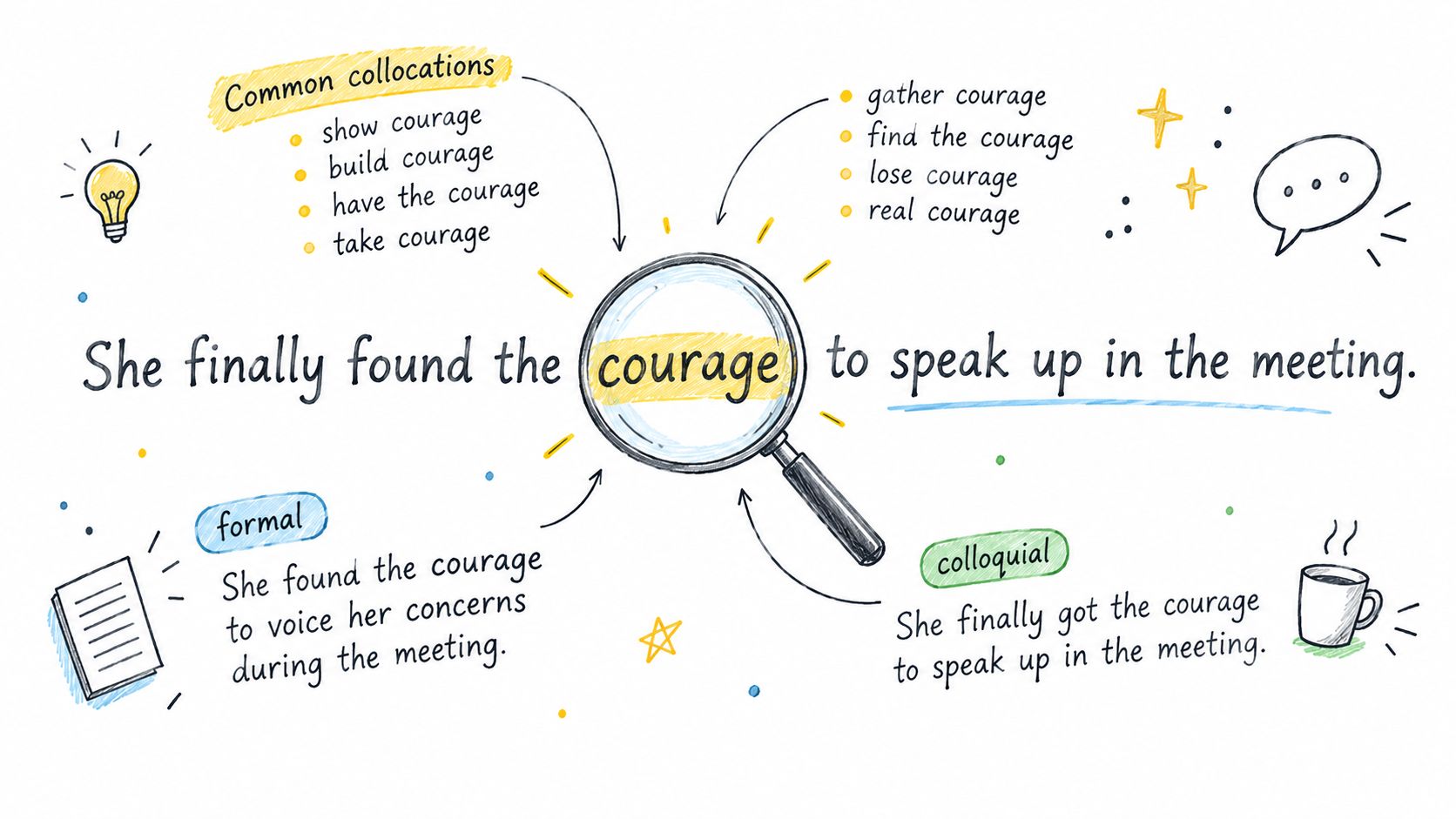
Isolated word lists are efficient to create and difficult to use. A word in a sentence shows its meaning, grammar, collocations, register and likely setting. Intermediate learners need that surrounding information because knowing a translation doesn't guarantee that a phrase will sound natural.
Capture vocabulary during reading, listening or conversation. Save the sentence where it appeared, then add a note if the expression is formal, casual, regional or specialised. For a word with several meanings, keep separate examples rather than forcing every use into one definition.
Learn the surrounding pattern
A Spanish learner shouldn't save only acuerdo when the useful phrase is llegar a un acuerdo. A French learner benefits more from prendre une décision than from memorising décision alone. An Italian learner should notice the full structure in avere voglia di fare qualcosa, including the preposition and following verb.
Review the sentence first, cover the target phrase and reconstruct it. Then use the phrase in a new context. Ask:
- What usually follows it? Check the preposition, verb form or noun pattern.
- Who uses it? Notice whether it belongs to conversation, work, news or academic writing.
- What changes its meaning? Compare it with a similar expression in another sentence.
Keep the bank selective
Saving everything creates a second dictionary. Save expressions you've encountered more than once, need for a current goal or want to use in an upcoming conversation. A unified word bank, such as LenguaZen's, keeps a phrase connected to the source sentence and makes it easier to move from recognition to production.
Measure contextual vocabulary by retrieval in new sentences. If you can recognise an item but can't adapt it, keep exposing yourself to examples before adding more cards. Depth of use matters more than the size of the list.
8. Listening Comprehension with Transcripts and Variable Playback Speed
Native-speed listening often feels impossible because spoken language removes the spaces that make written language clear. Speakers link sounds, reduce common words and move past unfamiliar phrases before you've analysed them. Transcripts let you connect the sound stream with visible language, but they should support listening rather than replace it.
Work with a short extract. Listen once for the general meaning, then read the transcript while listening. Mark the points where the written phrase was familiar but the sound wasn't. Finally, listen again without the transcript and check what has changed.
Use speed as scaffolding
Slowing difficult audio slightly can reveal word boundaries and pronunciation. It's a temporary aid, not the destination. Return to natural speed once the segment becomes manageable, and keep the same speaker or episode for repeated practice before moving to a new voice.
A Spanish learner might use a podcast transcript to notice reductions in everyday speech. A French learner can compare liaison and connected sounds with the written form. An Italian learner can replay a short interview and identify where intonation signals a question or emphasis.
Listening improves when you study the gap between what you recognised on the page and what you actually heard.
LenguaZen's native-speed podcast feature uses synced, tappable transcripts, and services supporting transcription for accessible learning demonstrate why searchable text can make audio easier to work with. You can also use YouTube or audiobook transcripts where available.
For a busy day, repeat one five-minute segment rather than starting a long episode you won't finish. Track how much of the segment you can summarise without reading, which phrases become audible and whether you need fewer pauses. Those signals show listening development more reliably than passive hours alone.
9. Spaced Reading with Repeated Encounter and Active Annotation
Reading once for general meaning is useful. Reading the same text again with a different purpose is more powerful for intermediate learners because each pass frees attention for another layer, first the argument, then the details, then the language used to express them.
Choose authentic material connected to your interests. A Spanish learner might read an article from El País, a French learner could work with a piece from Le Monde and an Italian learner might choose a contemporary blog or short literary extract. If the subject is unfamiliar and the language is dense, the combination can become unnecessarily demanding.
Change the question on each pass
On the first reading, skim for the main point and identify the people, places or claims. On the second, look up only words that block understanding and annotate important details. On the third, study phrasing, connectors, verb choices and style.
Your notes might say:
- Spanish: “The writer uses the subjunctive here because the statement expresses doubt.”
- French: “This connector introduces contrast rather than simple sequence.”
- Italian: “This phrase is more formal than the expression I use in conversation.”
Capture a small selection of useful expressions. Don't turn every article into a vocabulary harvest. The best items are those that help you discuss the text, appear in related material or fill a gap in your own writing.
Make progress visible
Reread after a gap and compare your understanding with the first pass. Can you explain the argument faster? Can you identify the writer's attitude? Can you reuse one of the expressions in a summary?
You can also track reading speed qualitatively by timing a comparable passage and recording how often you stop. The meaningful signal isn't speed alone. It's the combination of faster comprehension, better detail recall and more confident reuse of the author's language.
10. Focused Grammar Study with Contextual Application
Intermediate grammar study works when it answers a communication problem. Reading a rule, completing a worksheet and moving on may produce temporary accuracy, but learners often lose the structure when they need it in conversation. Study one difficult feature, then apply it immediately in meaningful language.
Common targets include the Spanish subjunctive, the distinction between preterite and imperfect, French object pronouns, complex prepositions and Italian tense or pronoun patterns. The exact problem depends on your output. Your own recurring errors should decide what deserves attention.
Use a short explanation, then produce
Start by asking what the structure communicates. In Spanish, compare a statement of fact with a reaction, desire or uncertainty. In French, examine how pronoun position changes around a verb. In Italian, compare two ways of describing a completed event and an ongoing background action.
Collect natural example sentences, then create contrasts:
- Spanish: Creo que viene versus No creo que venga. Explain the change in meaning.
- French: Compare a sentence with a direct object pronoun and one with a noun phrase.
- Italian: Describe what happened, then describe what was already happening when it occurred.
Use the structure in a journal entry or speaking task within the same study cycle. LenguaZen lessons can connect explanations with audio, video, writing prompts and role-play, but a textbook, teacher or grammar channel can work if you complete the application yourself.
Grammar earns its place when it helps you say something more precisely, politely or naturally.
Don't target several complex structures at once. Revisit the same feature after a few days and look for it in authentic input. Measure progress by successful use in new sentences, fewer corrections in later writing and improved accuracy during unrehearsed speaking. Understanding a rule is useful, but using it when meaning matters is the test.
Comparison of 10 Language Learning Techniques
| Technique | Implementation complexity | Resource requirements | Expected outcomes | Ideal use cases | Key advantages |
|---|---|---|---|---|---|
| Comprehensible Input | Medium, requires careful curation | Authentic media, transcripts, sustained exposure time | Improved passive fluency and pattern recognition | Intermediate learners seeking natural exposure | Natural acquisition of language patterns; engaging |
| Spaced Repetition Systems (SRS) | Medium, algorithm and deck setup | SRS software, curated cards/sentences, daily review time | Long-term retention of vocabulary and facts | Vocabulary consolidation and long-term review | Efficient retention with minimal daily time |
| Free Speaking & Output Production | High, requires feedback channels | Conversation partners or AI tutors, regular practice sessions | Greater spoken fluency, spontaneity, and confidence | Breaking intermediate plateaus; real communication | Builds production skills with corrective feedback |
| Immersive Media + Active Vocabulary Extraction | High, active capture workflow | Native-speed media, synced transcripts, capture tools | Authentic vocabulary knowledge and listening ability | Motivated learners who prefer media-based learning | Highly engaging; vocabulary tied to real context |
| Structured Dialogue & Role-Play Scenarios | Medium, scenario design and branching | Scenario scripts, prompts, AI/human partners, feedback | Functional conversational competence and register control | Practical situational practice and test prep | Safe, repeatable practice of real-world tasks |
| Journaling & Written Output with Feedback | Low–Medium, platform plus reviewers | Writing prompts, AI/tutor feedback system, revision time | Improved written fluency, grammar understanding, style | Developing written expression and self-reflection | Explanatory corrections that teach rules in context |
| Contextual Vocabulary Building (Word-in-Sentence) | Medium, requires sentence examples | Example sentences, corpora/media, SRS integration | Usable vocabulary with collocations and register awareness | Learners wanting usable, not just translated, words | Deep, context-rich vocabulary knowledge |
| Listening Comprehension with Transcripts & Variable Speed | Medium, audio-text sync tools | Native audio, quality transcripts, variable-speed player | Improved real-world listening and sound-to-text mapping | Tackling native-speed content and accents | Scaffolds listening with transcript support |
| Spaced Reading with Repeated Encounter & Annotation | Medium–High, multi-pass workflow | Authentic texts, annotation tools, time for multiple readings | Reading fluency, stylistic awareness, deeper comprehension | Advanced reading comprehension and analysis | Deepens understanding through repeated, active reading |
| Focused Grammar Study with Contextual Application | Low–Medium, targeted lesson design | Concise explanations, contextual examples, practice tasks | Accurate use of specific structures and metalinguistic insight | Fixing particular grammar gaps in intermediate learners | Efficient, function-focused grammar transfer to output |
Build a Routine That Survives Busy Weeks
Ten techniques don't belong in ten daily study blocks. The workflow is more sustainable when you combine a few functions in one session: understand something real, save only useful language, recycle it and produce a response. That approach also reflects the practical needs of UK learners. The British Council and YouGov found that 36% of surveyed UK adults identified time constraints as a barrier, while 20% cited lack of perceived need and 19% financial constraints in the same survey of 3,000 adults. Those findings support short, useful routines rather than elaborate programmes that collapse when a busy week begins.
A fifteen-minute routine can be enough to maintain the chain. Listen to a short segment with a transcript, save one or two contextual phrases and say a brief summary aloud. If you have thirty minutes, add spaced review, write a few sentences or repeat the listening without support. The point isn't to squeeze every technique into the session. It's to move language through the workflow from understanding to use.
A weekly routine can rotate the emphasis:
- Input day: Watch a video or read an article connected to your interests.
- Recycling day: Review contextual phrases and create new sentences.
- Output day: Speak freely, complete a role-play or record a response.
- Correction day: Journal, review feedback and rewrite selected passages.
- Grammar day: Target one recurring error and use the structure in output.
- Repetition day: Rewatch, reread or relisten to material from earlier in the week.
- Real-world task day: Complete a practical scenario, such as making a request, explaining a problem or giving an opinion.
You can adapt the balance to your goal. Someone preparing for study abroad may prioritise role-play, listening and functional writing. A professional may need formal email output and meeting language. Someone returning to Spanish, French or Italian after a long break may begin with familiar media and carefully controlled speaking before increasing difficulty.
Track evidence that reflects actual ability. Keep a small record of contextual phrases you can use without prompting, the same audio segment you can understand with fewer supports, the length and flexibility of your spoken responses, recurring corrections in writing, successful role-play outcomes and grammar structures that appear accurately in new contexts. Don't treat a longer study streak or a larger flashcard collection as proof of fluency.
A unified tool can reduce friction, but it isn't a substitute for judgement. LenguaZen brings imported YouTube videos, native-speed podcasts, synced transcripts, contextual word saving, spaced review, journal corrections, AI chat and role-play into one environment. That may suit learners who are tired of switching between a media player, flashcards, a translator, a grammar resource and a speaking platform. Others may prefer separate tools, especially if they already have a tutor or a trusted reading system.
The strongest routine is the one you can restart after an interrupted week. Keep a minimum version ready: one short piece of input, one saved phrase, one spoken or written response. When time returns, expand the same cycle instead of beginning a completely new course. Progress beyond the plateau comes from repeated contact between comprehension and production, not from endlessly preparing to use the language later.
LenguaZen brings real-world Spanish, French and Italian input together with synced transcripts, contextual vocabulary saving, spaced review, tutor-style writing corrections, AI speaking practice and role-play. If you want one workflow for understanding more, producing more and recycling useful language, visit LenguaZen and explore how it fits your routine.