Comprehensible Input Spanish: Key to Fluency
Comprehensible input is Spanish you mostly understand, around 90%, with enough new language to sit just above your current level and make your brain infer meaning naturally. For learners stuck between textbook knowledge and real conversation, that balance is often the missing bridge to fluency.
You may recognise this feeling. You've completed beginner courses, memorised irregular verbs, and learnt enough phrases to order food or ask for directions. Then a Spanish speaker answers at normal speed, links several words together, and leaves you searching through grammar rules that never arrive quickly enough.
That experience doesn't mean you're bad at languages. It usually means your study has trained you to recognise Spanish as an exercise, not process it as a living message. Comprehensible input gives your brain repeated contact with meaningful Spanish, while carefully supporting the parts you don't yet understand.
Table of Contents
- Escaping the Intermediate Plateau with Comprehensible Input
- Understanding the Core Concept of Comprehensible Input
- Why UK Data Shows a Critical Need for This Approach
- Practical Examples of Comprehensible Input in Action
- Classroom Activities and Self-Study Workflows
- Common Misconceptions About Comprehensible Input
- Measuring Progress and Staying Motivated
Escaping the Intermediate Plateau with Comprehensible Input
The intermediate plateau often begins in silence. You understand textbook dialogues, but native podcasts still sound like a blur. You can form a sentence after thinking about it, yet spontaneous conversation feels far more difficult than your revision notes suggested.
Consider a learner who has spent years completing grammar exercises. She knows that hablé refers to a completed action and that hablaba describes an ongoing or habitual one. But during a conversation about childhood, she hears both forms in quick succession and can't decide which meaning belongs to which verb. Her knowledge is present, but it hasn't become automatic.
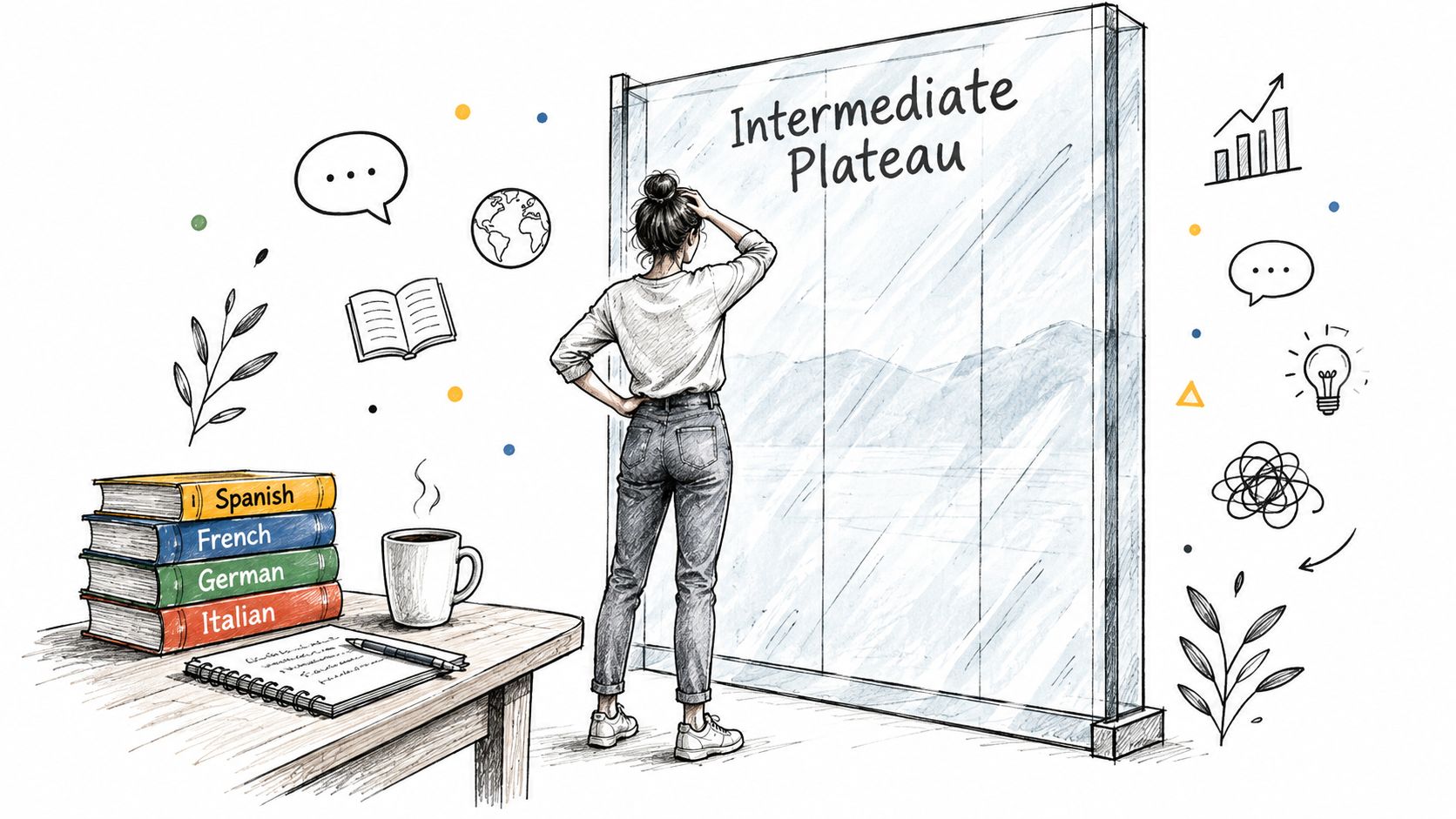
Comprehensible input changes the task. Instead of asking you to recall a rule before understanding a sentence, it surrounds new language with enough meaning for you to follow the message. A speaker might tell a story about a childhood holiday while showing photographs, repeating key expressions, or using familiar vocabulary around an unfamiliar verb. You notice how the language works because you're following the story, not completing a gap-fill exercise.
Why drills alone often stop working
Grammar drills have a useful role. They can draw attention to a confusing contrast, correct a recurring error, or prepare you for an exam. The problem comes when controlled practice becomes your main contact with Spanish.
A drill presents language as an object to manipulate. Real input presents language as something someone uses to explain, entertain, persuade, or connect. To broaden your vocabulary without losing that meaning-based connection, use resources such as this guide to broadening your vocabulary, then meet new words repeatedly in stories, conversations, and articles.
Practical rule: If you understand the message but occasionally miss a word, keep listening. If you can't follow the message at all, make the material easier.
The plateau starts to recede when Spanish becomes understandable enough to enjoy and challenging enough to stretch you. You're no longer collecting isolated answers. You're building a mental library of phrases, sounds, patterns, and meanings that can later support faster speaking.
Understanding the Core Concept of Comprehensible Input
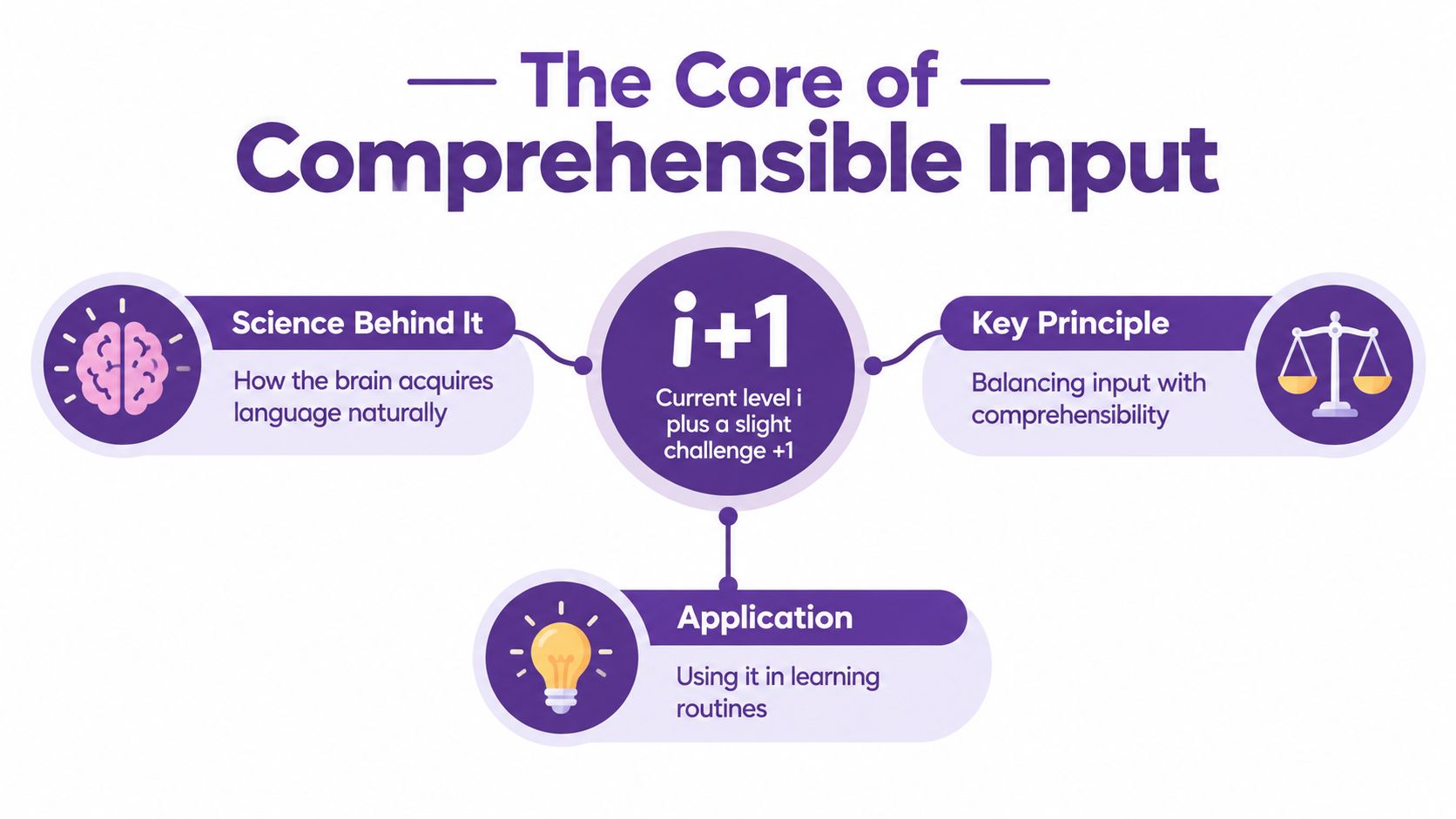
The central idea is simple: language acquisition grows from understanding messages. The British Council describes comprehensible input as exposure to language that learners can understand even though it sits slightly above their current ability, often expressed through the i+1 principle. Here, i represents what you already know, while +1 represents a manageable next step. The British Council's teaching research connects this principle with learning through understandable exposure rather than relying only on conscious rule study.
Think of the difference between two listening tasks. In the first, you hear a rapid interview full of unfamiliar slang and lose the subject after a few seconds. In the second, a Spanish speaker explains how they prepare breakfast, using familiar verbs and showing the ingredients, but introduces expressions such as a fuego lento. You understand the activity and can infer the new phrase from the context. The second example creates useful pressure without turning comprehension into guesswork.
What your brain is doing
When you focus on the message, your attention moves towards meaning. You notice that a phrase appears whenever a speaker describes something that happened before another event. You hear a pronoun attached to a verb in several situations. You begin to form expectations about what comes next, even before you can state the grammar rule.
That process differs from consciously memorising a table. Rule study can help you explain a form, but explanation and fluent use are different abilities. A learner may know the terminology for the subjunctive and still hesitate when saying quiero que vengas. Meaningful examples give the form a context that recall practice often lacks.
The balance matters
Input must be understandable, but it shouldn't be effortless. Material that's far below your level may feel comfortable without giving you much to notice. Material that's far above your level can become background noise because you have no reliable way to connect sound with meaning.
The British Council also stresses the importance of interesting listening and reading material, while UK-focused discussion of extensive target-language use and ACTFL guidance highlights the value of using the target language as much as possible while keeping it comprehensible. In practice, that means adjusting the support around the content. Use a transcript, visual clues, familiar topics, or a brief contextual translation when necessary, then return your attention to the Spanish message.
Why UK Data Shows a Critical Need for This Approach
Spanish has a strong position in UK education, but school uptake hasn't automatically produced conversational confidence. In England, Spanish was the most popular A-level language for the fifth consecutive year in 2024, according to the British Council's curriculum research review. The same source reports that Spanish GCSE entries rose from 85,217 in 2015 to 120,198 in 2024, an increase of about 41%.
The longer view tells a similar story. The British Academy reported Spanish GCSE entries increasing from 62,456 in 2005 to 112,845 in 2022, while French and German declined over that period. Spanish is clearly not a marginal school subject in the UK. Many learners encounter it during formal education, and that creates a substantial need for listening and reading practice after classroom lessons end.
Yet study and usable ability are not the same thing. The Cervantes Observatory's 2025 report on Spanish as a global language records that only 3% of British people could hold a conversation in Spanish in 2012. It cites later British Council figures of 4% in 2014 and 8% among people aged 18 to 34 in 2015. The report also says Spanish learners worldwide reached about 24.6 million in 2025, with one cited dataset counting 2,017,796 learners in the United Kingdom.
The real problem is the conversion gap
These figures don't prove that every classroom fails. They do show why a learner can spend significant time studying Spanish and still lack dependable conversational control. Exams may reward accurate answers within familiar formats, while everyday interaction demands rapid comprehension of accents, reduced sounds, connected speech, and unpredictable vocabulary.
Listening is especially important because it controls what you can respond to. If the incoming message arrives too quickly, your carefully learnt grammar remains inaccessible. Comprehensible input provides a bridge by making listening demanding but survivable, so your brain can build speed and pattern recognition through repeated meaning-based encounters.
For UK adults returning to Spanish, this approach also addresses a practical constraint. You may remember vocabulary from school but lack current listening stamina. Rather than restarting with beginner drills, choose material that respects what you know and supports what you've forgotten. The aim isn't more exposure. It's sustained exposure that you can process.
Practical Examples of Comprehensible Input in Action
Start with material that lets you follow the subject without translating every sentence. If a podcast discusses a familiar topic such as commuting, cooking, football, or work, context will carry part of the meaning. If the speaker's pace overwhelms you, switch to a learner-focused episode, choose a transcript, or select a shorter segment.
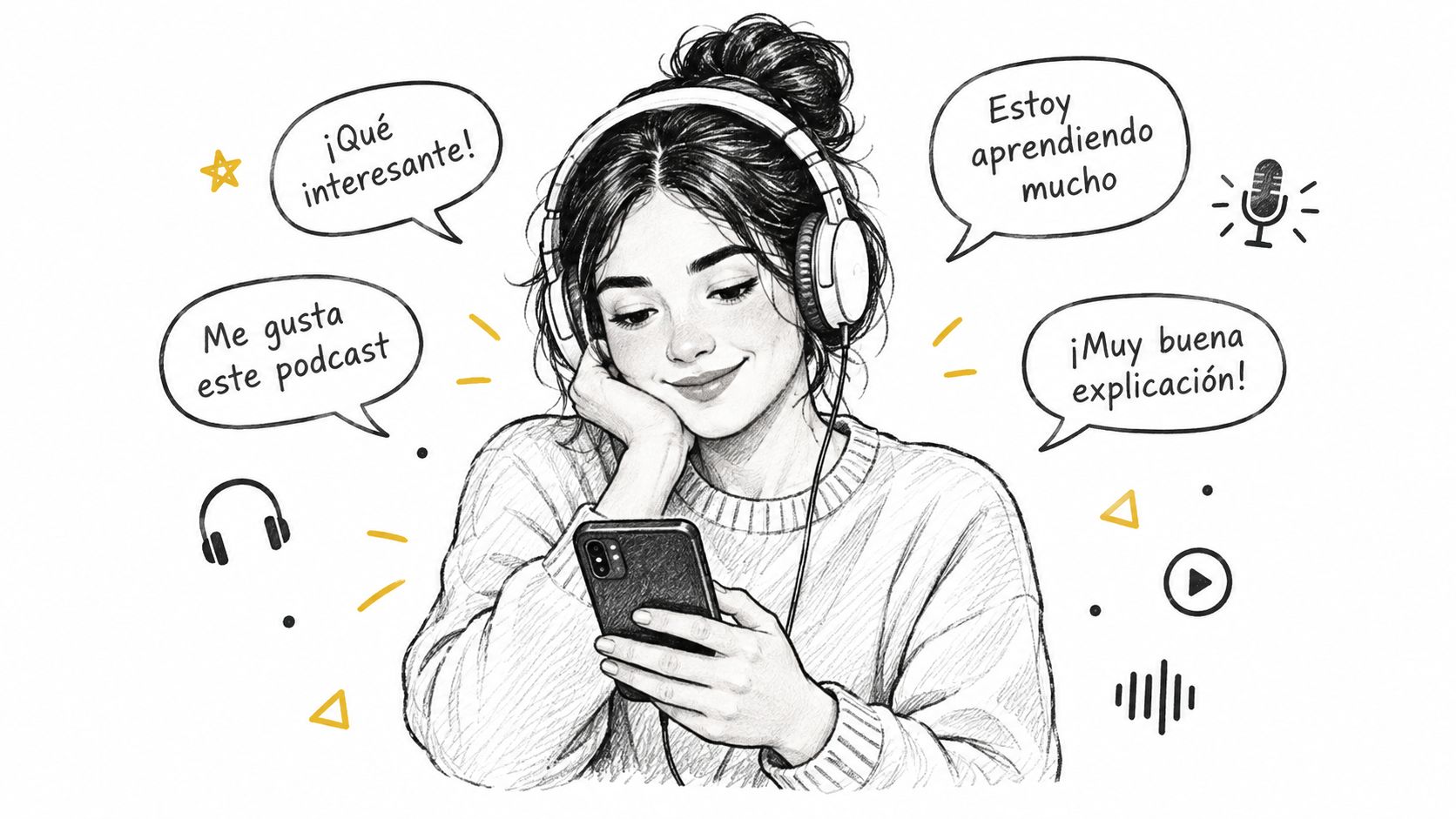
Listening with support
Use a three-pass routine:
- First pass, follow the message. Listen without pausing. Ask yourself who is speaking, what happened, or what problem the speaker is describing.
- Second pass, notice useful language. Read the transcript or same-language subtitles. Mark phrases that seem important, but don't stop for every unknown word.
- Third pass, listen again. Remove the transcript and check whether the sounds now connect more easily.
A Spanish podcast with a transcript works particularly well because the written support helps you identify words that you already know but failed to recognise in connected speech. The transcript isn't a replacement for listening. It's a temporary scaffold that helps sound and meaning meet.
Here's a useful test. After listening, explain the topic in simple English or Spanish without looking at your notes. If you can summarise the main point but missed some details, the content may be at a productive level. If you can't identify the topic, choose easier material before increasing exposure.
For a visual example of supported Spanish listening, use the following video:
Reading that feeds speaking
Choose graded readers, short news articles, personal essays, or familiar novels in Spanish. Read once for the situation and argument, then return to a small number of phrases that you could imagine using. For example, don't save every form of dar you meet. Save a useful chunk such as darse cuenta de que and write a sentence about your own life.
Writing and speaking complete the loop. Keep a short journal, describe what you listened to, or respond to the article's main idea. You can then compare your wording with the language you've encountered. Output reveals gaps, while new input supplies patterns for filling them.
Keep the flow: Save language that helps you understand or express the message. Ignore low-value vocabulary that appears once and doesn't matter to the topic.
Classroom Activities and Self-Study Workflows
A classroom can make comprehensible input social and responsive. A teacher can tell a story with drawings, gestures, objects, and repetition, then ask questions that check meaning rather than grammatical terminology. Sustained silent reading gives students control over pace, while follow-up discussion turns the text into a reason to speak.
Task-based activities also create a useful contrast with isolated exercises. In a classroom using task-based language teaching, learners might plan a route, compare two flats, or solve a practical problem in Spanish. The teacher supplies language and clarification as needed, but the task gives every phrase a purpose.
Self-study needs a little more organisation because no teacher is choosing the next piece of input for you. A simple workflow can prevent random browsing from replacing deliberate practice:
| Stage | Classroom version | Self-study version |
|---|---|---|
| Choose | Teacher selects an understandable story or task | Pick a podcast, video, or article on a familiar subject |
| Support | Teacher uses gestures, images, and reformulation | Use a transcript, visuals, or same-language subtitles |
| Notice | Discuss useful phrases after comprehension | Save a few phrases with their original sentences |
| Produce | Retell, role-play, or solve a problem | Write a response or record a short explanation |
| Recycle | Revisit language in a later activity | Review saved phrases and meet them in new content |
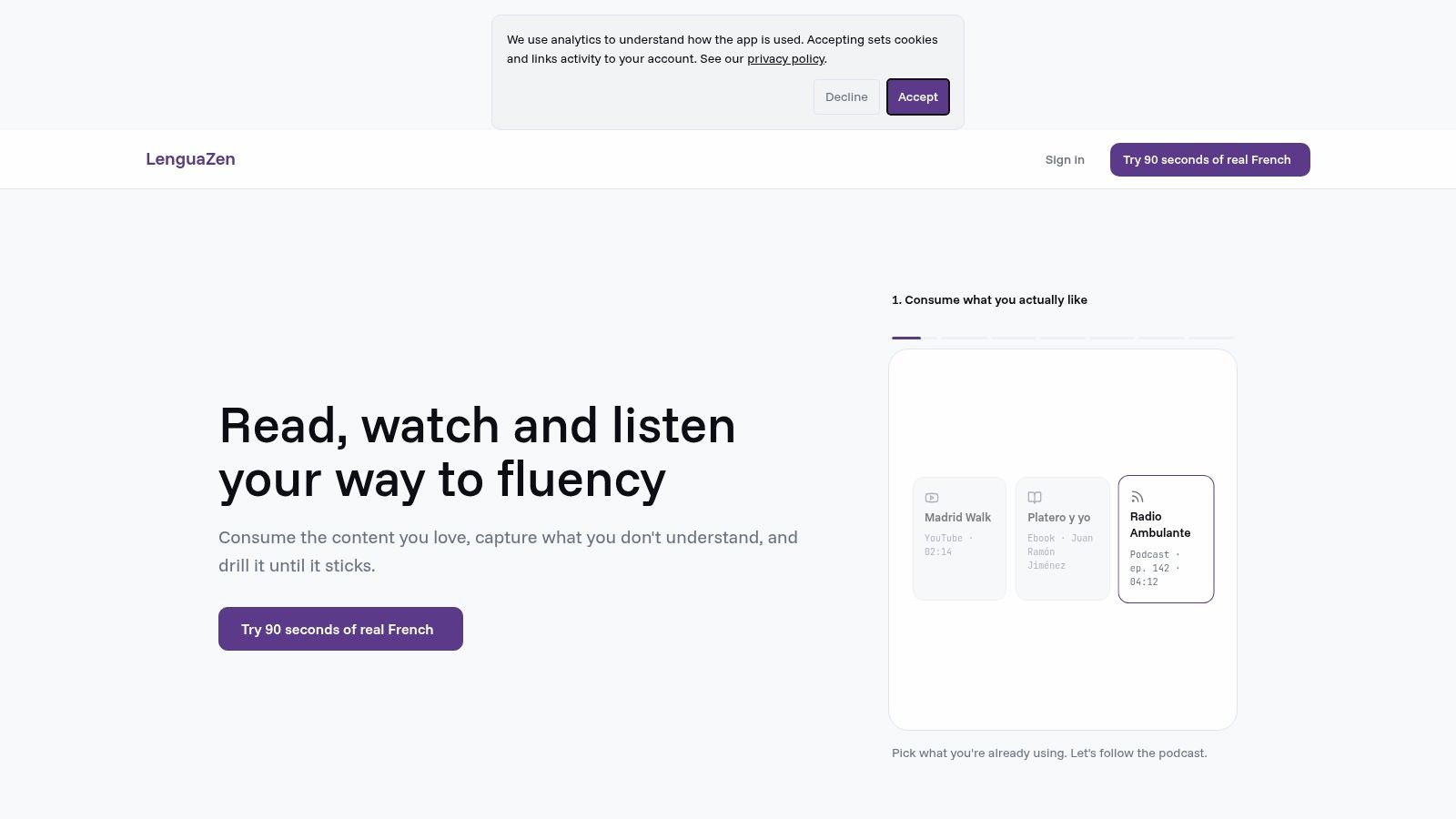
LenguaZen is one option for this kind of routine. It combines imported YouTube videos and native-speed podcasts with synced, tappable transcripts, contextual translations, saved vocabulary, journal writing with AI corrections, and speaking practice through AI chat. That setup can reduce the friction of moving from input to a short piece of output, provided you still choose content you can understand and engage with.
The important distinction is control. A classroom offers immediate adjustment and human interaction. Self-study offers flexible timing and personal choice. Both work better when input leads to production, and production sends you back to specific language you need to notice again.
Common Misconceptions About Comprehensible Input
You don't need to understand every word. If you pause whenever a new word appears, you turn listening into dictionary work and lose the larger message. Unknown language is useful when the surrounding context gives you a reasonable way to infer its meaning.
That doesn't mean you should tolerate complete confusion. If you miss the topic, the relationships between speakers, and the main events, the material is too difficult or needs stronger support. Lower the level, add a transcript, or choose a more familiar subject.
Comprehensible input isn't passive background noise. Listening while distracted may expose you to Spanish sounds, but it gives your attention little chance to connect those sounds with meaning. Engaging content works differently. You follow an argument, laugh at a story, or try to predict what happens next.
It doesn't replace every other form of study. Targeted grammar practice can clarify a persistent problem. Pronunciation feedback can help you change a sound. Conversation gives you pressure to retrieve language. Input supplies the examples that make these activities meaningful.
Useful distinction: Comprehension is the foundation, not the finished building.
The common mistake is treating input as an alternative to effort. It still requires selection, attention, repetition, and patience. The difference is that your effort serves communication rather than remaining trapped in exercises.
Measuring Progress and Staying Motivated
Track changes in what you can do, not only how much time you spend studying. At the end of a listening session, write down the topic, the main point, and one detail you understood. Repeat a similar task later with a different speaker or subject. Your notes will show whether comprehension is becoming faster and more precise.
Use small tests that resemble real life:
- Listening: Follow a short podcast segment without subtitles, then check your summary against the transcript.
- Reading: Read an article and identify its position before looking up unfamiliar vocabulary.
- Speaking: Retell a story or explain an opinion without preparing every sentence.
- Writing: Keep a brief journal entry and mark the phrases you had to translate or construct slowly.
Progress won't appear evenly. You may understand a familiar speaker comfortably one day and struggle with a different accent the next. That isn't failure. Comprehension depends on vocabulary, topic knowledge, speed, pronunciation, and the support available at that moment.
Build a routine you can repeat
Choose one reliable listening source, one reading source, and one output activity. Keep the content interesting enough that you'll return to it, then adjust difficulty when comprehension consistently feels effortless or consistently collapses.
A practical weekly rhythm might look like this:
- Listen to a supported Spanish episode and summarise it.
- Read a related article and save a few reusable phrases.
- Write a short response using those phrases.
- Speak about the same topic without reading your notes.
- Revisit the audio and notice what sounds clearer.
The goal isn't to wait until speaking emerges perfectly from listening. Give yourself regular, low-pressure chances to produce Spanish, then use the difficulty of that production to choose better input. With a sustainable routine, the intermediate plateau becomes a diagnosis, not a permanent destination.
LenguaZen brings Spanish listening, synced transcripts, contextual vocabulary review, journal corrections, and judgment-free speaking practice into one workflow for intermediate learners. Visit LenguaZen to turn understandable input into regular reading, writing, and speaking practice.